What It Is and How to Get Through It
By Harshad | Founder, Indieedogs | Puppy Training & Behaviour Specialist
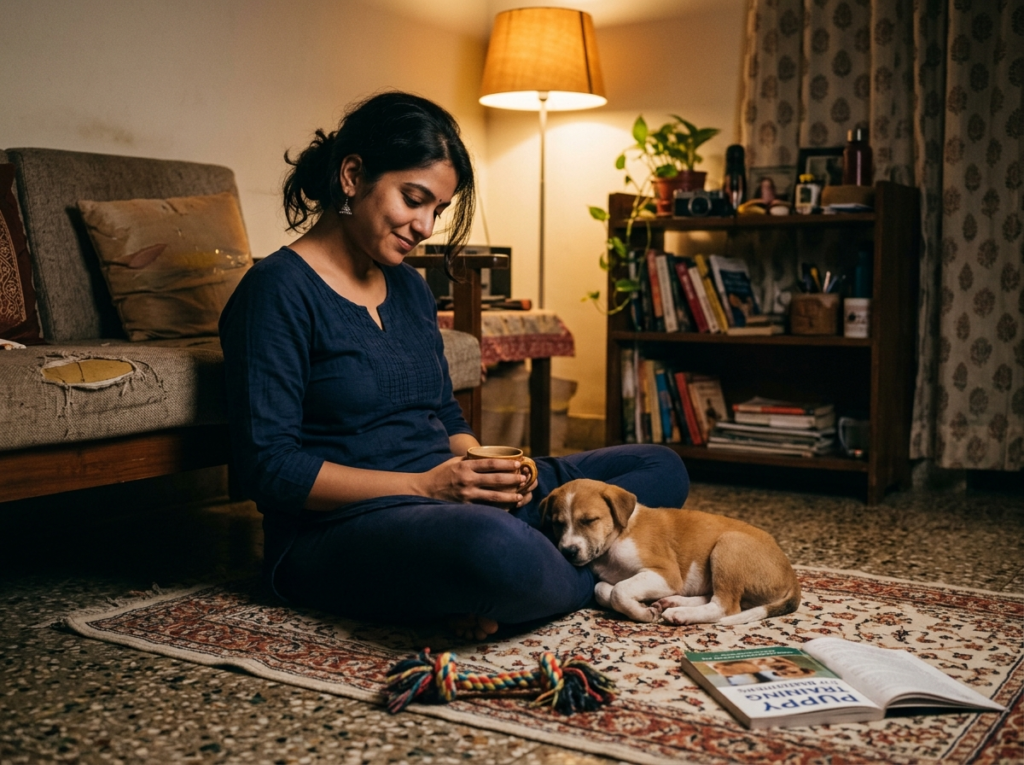
If you’re reading this at 2am because your new puppy won’t stop crying and you’re sitting on the bathroom floor wondering what you’ve done to your life — this blog is for you.
Or if you’re reading it during a quiet moment of the day, feeling a heaviness you didn’t expect, a sense of dread when you think about the months ahead, a quiet voice in the back of your mind saying ‘I’ve made a terrible mistake’ — this blog is also for you.
What you’re experiencing has a name: puppy blues. It’s real. It’s extremely common. And — this is the most important thing — it almost always gets better.
I’m not going to give you a training tip right now. I’m not going to tell you about socialisation windows or bite inhibition. Right now I want to sit with you in what you’re feeling, explain what’s happening, and tell you the truth: you haven’t made a mistake. You’re going through something that millions of pet parents have gone through — and the dog you’re going to love for the next 15 years is on the other side of this.
1. What Puppy Blues Is — The Proper Definition and Why It Happens
Puppy blues is the name given to the intense emotional overwhelm, anxiety, regret, and exhaustion that many new dog owners experience in the first days and weeks after bringing a puppy home. It’s not a clinical diagnosis — but it’s a genuinely recognised phenomenon, and the experience is as real as any other form of emotional distress.
The comparison to postpartum baby blues is intentional — and accurate:
| 😢 Puppy Blues | 🌱 Baby Blues / Postpartum Low |
| Triggered by: a new puppy entering the home Timing: Days 1–14 are the peak Core feelings: regret, overwhelm, resentment, exhaustion, loss of freedom Physical symptoms: disrupted sleep, appetite changes, constant anxiety Thought patterns: ‘I made a mistake.’ ‘I can’t do this.’ ‘I’ve ruined my life.’ Resolution: Typically 2–8 weeks. Almost always fully resolves. Who gets it: Anyone. More common in first-time dog owners and those without family support. India context: Heightened by lack of community support, pet-unfriendly housing culture, and judgement from family members who questioned the decision. | Triggered by: a new baby entering the home Timing: Days 3–10 are the peak (hormonal crash post-birth) Core feelings: sadness, anxiety, detachment, overwhelming responsibility Physical symptoms: disrupted sleep, crying spells, physical exhaustion Thought patterns: ‘Am I bonding? Am I doing this right? Did I ruin everything?’ Resolution: 2–3 weeks for baby blues; longer if it becomes postpartum depression Who gets it: Mostly primary caregivers post-childbirth Key similarity: Both involve a sudden irreversible commitment, sleep deprivation, and identity disruption. |
Why It Happens
Puppy blues happens because bringing a puppy home is a genuinely destabilising life event — and our culture doesn’t prepare us for that. We expect joy. We’ve seen the photos, watched the Instagram reels, heard the stories of unconditional love. Nobody warned us about the other part.
Here’s what’s actually happening in the first two weeks:
- Sleep deprivation — a new puppy can wake you 2–4 times a night for the first week. Sleep loss alone is enough to produce anxiety, lowered mood, and cognitive distortion.
- Identity disruption — your daily routine has been completely reorganised around a small creature’s needs. This is a loss even when it’s chosen.
- Irreversibility — unlike most difficult decisions, this one feels permanent. The sense of ‘I can’t undo this’ amplifies every difficult moment.
- Expectation gap — the puppy you imagined and the puppy you have are almost never the same. The gap between those two is a significant emotional weight.
- Social pressure — in India especially, if family members questioned the decision or colleagues said ‘why would you get a dog in a flat,’ the blues comes with an added layer of ‘and they were right’ that makes everything heavier.
- Hypervigilance — your nervous system is on constant alert: is the puppy safe, have they eaten, why are they crying, is that normal. Sustained hypervigilance is physiologically exhausting.
None of this means you made the wrong decision. All of it is completely understandable given what you’re going through.
| 💛 You Are Not Alone |
| Studies suggest that up to 60–70% of new puppy owners experience some degree of puppy blues. |
| The number in India is likely higher — fewer support systems, more family pressure, smaller living spaces. |
| The people who don’t talk about it publicly are not people who didn’t feel it. |
| They’re people who felt it, got through it, and can now barely remember it. |
| You will be one of those people. Soon. |
2. Why the First 2 Weeks Are the Hardest — and Why It Almost Always Gets Better
| The First Two Weeks The hardest stretch of puppy ownership. And the one with the shortest remaining distance to better. |
The first two weeks are the hardest for a reason that is both obvious in hindsight and easy to miss in the moment: you are adapting to maximum disruption with minimum competence and zero history of positive moments to draw on.
Think about what’s happening simultaneously in those first 14 days:
- You’re completely sleep-deprived — possibly the most sleep-deprived you’ve ever been
- You’re learning how to care for an animal you’ve never cared for before
- The puppy is not yet sleeping through, not yet toilet trained, not yet bonded to you
- You haven’t had a single week of ‘before’ to compare the hard days to
- You’ve had no positive experiences to offset the difficult ones yet
That’s an enormous amount of difficulty compressed into a very short window with no emotional counterweight. Of course it feels like too much. It is a lot.
Here’s what changes after those first two weeks, and why it changes:
- Sleep begins improving — slowly, imperfectly, but measurably. Even one slightly better night changes everything.
- The puppy starts to recognise you — their behaviour shifts subtly toward you specifically. They come to you. They settle near you. You become their person.
- Routines start to form — the day becomes slightly more predictable. Predictability is a profound relief to an overwhelmed nervous system.
- You have positive moments to hold — the first time the puppy curls up on your lap, the first real play session, the first successful toilet trip. These accumulate.
- Your competence increases — you know when they need to go out, you can read some of their signals, you know what they like. Competence reduces anxiety directly.
These changes don’t happen all at once. They don’t happen on Day 15 as if a switch flips. They happen incrementally, quietly, and often only visible in retrospect. But they happen. In almost every case, they happen.
| 📌 The Most Important Thing to Know About Week 2 |
| Week 2 is almost always better than Week 1. |
| Week 3 is almost always better than Week 2. |
| The trend is real. You are not stuck. You are moving through something. |
| If Week 2 feels the same as Week 1 — it is because you are in it, not because it isn’t moving. |
| It is moving. You just can’t see it from inside. |
3. The Physical and Emotional Symptoms Parents Often Don’t Recognise
One of the reasons puppy blues is so disorienting is that many of its symptoms feel like character flaws rather than a recognisable emotional response. You don’t think ‘I’m experiencing puppy blues.’ You think ‘I’m a bad person for feeling this way.’ Or ‘I’m not cut out for this.’ Or ‘something is wrong with me.’
Nothing is wrong with you. Here’s what the symptom actually looks like — and what it actually means:
| Symptom | What It Feels Like | What It Actually Means |
| Regret spirals | ‘I should never have got a dog.’ ‘What was I thinking?’ Intrusive thoughts that replay the decision on a loop, especially at 2am during a puppy crying episode. | This is one of the most common symptoms — and one of the most frightening, because it feels so certain. It is not a conclusion. It is a thought pattern produced by exhaustion and overwhelm. Almost every parent who has these thoughts looks back later and cannot believe they felt that way. |
| Resenting the puppy | Looking at the puppy and feeling irritation, even anger — not the overwhelming love you expected. Feeling nothing, or feeling trapped, when you expected to feel joy. | Absence of the anticipated love-at-first-sight feeling is normal and does not reflect the quality of the bond you will build. Attachment develops over time. It is not instant for puppies, babies, or humans. |
| Grief for your old life | Missing the freedom, the clean house, the uninterrupted sleep, the spontaneous weekend plans — and feeling guilty about missing it. | This is legitimate grief. Something did change. Your previous life genuinely does look different now. The grief is real and worth acknowledging. It coexists with the decision being right. |
| Physical exhaustion | Disrupted sleep from night crying. Hypervigilance — always listening for the puppy, never fully resting. Physical tension from constant monitoring. | Puppy blues and sleep deprivation are deeply intertwined. Almost every symptom becomes more extreme with less sleep. The first concrete thing to do is protect sleep — even 20 minutes. |
| Social withdrawal | Not wanting to talk about the puppy publicly because you feel shame about your feelings. Feeling like everyone else’s puppy experience is better than yours. | Social media shows puppies as unambiguous joy. It does not show the 3am whimpering, the biting, the destroyed furniture, or the tears. The comparison is false. Your experience is not abnormal. |
| Physical anxiety symptoms | Racing heart when the puppy cries. Stomach tension when anticipating another difficult walk. Sense of dread when waking up to face another day. | The nervous system has been genuinely destabilised by a sudden, large life change. These are physiological responses to a real stressor — not signs of weakness or poor mental health. |
| Intrusive thoughts about rehoming | Researching ‘how to rehome a dog’ or ‘puppy rescue India.’ Planning exit strategies. This feels shameful but is extremely common. | Having the thought does not mean you will act on it, and it does not mean you should. Most people who have these thoughts during the puppy blues phase never rehome their dog and cannot imagine doing so six months later. |
The India-Specific Layer
Indian pet parents often carry an additional weight that international resources don’t address. In India, the decision to get a dog in an urban setting — especially an apartment — often comes with family resistance, judgement from neighbours, housing society complications, and a culture that doesn’t yet have the infrastructure of dog parks, pet-friendly restaurants, or puppy classes on every corner.
When the puppy blues hits, that pre-existing resistance from people around you feels like confirmation. ‘See, I told you it was too much.’ The blues is hard enough without that echo. What I want you to know is this: every single Indian pet parent who was told it was too much and got a dog anyway — the vast majority of them are glad they did. The judgement doesn’t disappear, but it stops being the loudest voice.
| 🇮🇳 For Indian Pet Parents Specifically |
| You may not have family support. That’s harder. Not impossible. |
| You may be managing this in a 2BHK with a housing society that frowns on dogs. That’s harder. |
| You may be doing this without a single friend who has been through it. That’s harder. |
| Harder doesn’t mean wrong. It means you need more grace — extended to yourself. |
| India’s dog parent community is growing fast. You are not as alone as it feels right now. |
4. Why Puppy Blues Does Not Mean You Made the Wrong Decision
| The Hardest Thought You’re wondering if you made a mistake. You didn’t. Here’s why the feeling lies. |
This section is the one I most want you to read, and the one I want you to come back to on the hardest days.
When you’re in the middle of puppy blues, the thought ‘I made a mistake’ feels like a clear-eyed conclusion. It feels like reality. It feels like the exhaustion and the difficulty and the regret are simply telling you something true — something you should have seen before.
But here’s what’s actually happening: an exhausted, overwhelmed, sleep-deprived brain cannot accurately evaluate long-term decisions. It can only evaluate the present moment. And when the present moment is 3am, the puppy is crying, you have work at 8am, and you haven’t slept properly in a week — the present moment is genuinely terrible.
The mistake isn’t in the decision. The mistake is in believing that a genuinely terrible present moment can reliably tell you anything about a 15-year relationship.
Let me give you some evidence from the other side:
I have talked to hundreds of Indian pet parents. I have never — not once — spoken to someone who came out the other side of puppy blues and said ‘I wish I hadn’t got the dog.’ The people who rehomed during puppy blues — many of them carry lasting regret. The people who got through it almost universally describe what came after as one of the most meaningful relationships of their lives.
The feelings you’re having are not a verdict on the decision. They are a normal response to a genuinely hard situation — one that almost everyone goes through, one that passes, and one that you will look back on as the price of admission to something extraordinary.
What Real Regret Looks Like vs Puppy Blues
There’s one question worth sitting with honestly: is this exhaustion and overwhelm speaking — or is something deeper being said? The difference matters.
- Puppy blues sounds like: ‘This is so hard, I didn’t expect it, I feel like I’m failing, I’m not sure I can do this.’ These thoughts are provisional, present-tense, and driven by exhaustion.
- Genuine incompatibility sounds like: ‘I have a specific, stable reason why a dog cannot work in my life right now — a health situation, a housing situation, a life change — that is not going to change.’ These thoughts are concrete, future-oriented, and not driven by exhaustion alone.
For 95% of people reading this, what you’re experiencing is the first category. If you genuinely believe it might be the second — that’s a different conversation, and it deserves to be had calmly, rested, with someone who can help you think clearly. Not at 3am.
| 💚 This Is What I Need You to Hold Right Now |
| The love comes later. It comes after the work, not before it. |
| The bond doesn’t arrive — you build it. And you’re already building it. |
| Every feed, every toilet trip, every 3am comfort: you are constructing something. |
| You cannot see it yet from inside the construction site. |
| But it is being built. It is real. And it is yours. |
5. Practical Things That Genuinely Help Right Now
Not someday. Not when it gets easier. Right now, this week, with the energy you actually have. These are the things that actually move the needle on puppy blues — not because they fix the situation, but because they reduce the weight you’re carrying inside it.
| What to Do | How to Do It | Why It Actually Helps |
| Protect one hour of sleep | Hand the puppy to someone else, use a crate, set an alarm, do whatever it takes — but get one uninterrupted sleep window per day, even if it’s a midday nap. | Sleep deprivation is a direct amplifier of every negative emotion. One hour of protected rest changes your capacity to cope by more than you’d expect. This is medicine, not a luxury. |
| Reduce the planning horizon | Stop thinking about ‘what if this is forever.’ Think only about the next 3 hours. What does the puppy need in the next 3 hours? What do you need? That’s all. | The overwhelm of puppy blues is often future-projection — imagining all the hard work ahead simultaneously. Breaking time into 3-hour windows makes it manageable. The 3-hour problem is almost always solvable. |
| Name what you’re feeling — out loud | Say it to a partner, a friend, a parent, or even just to yourself: ‘I’m struggling. I didn’t expect it to feel like this. This is harder than I thought.’ | Naming an emotion reduces its intensity — this is established neuroscience. Shame and secrecy amplify puppy blues. Saying it out loud, even once, breaks the loop. You don’t need a solution. You need to say it. |
| Find one other person who has been through it | A friend, an online community, a building neighbour who has a dog. Not for advice — just for ‘I felt exactly the same thing.’ | Isolation is the biggest amplifier of the shame spiral. Hearing ‘me too’ from one person you trust is more effective than any technique. In India, dog parent WhatsApp groups and Instagram communities are genuinely helpful here. |
| Create one small daily non-puppy window | 20 minutes with a cup of chai and a book. 15 minutes of music with headphones. 10 minutes on the balcony alone. Label it as yours and protect it. | Identity erosion — feeling like you have become only ‘the puppy’s person’ — is a real contributor to puppy blues. One small protected window reminds your nervous system that you still exist independently. |
| Lower your standards deliberately and completely | Accept that the house will not be clean. Training will not be perfect. Some days will be survived, not won. Lower the bar to ‘we both ate and the puppy is safe.’ | Perfectionism makes puppy blues significantly worse. The gap between ‘the experience I expected’ and ‘the experience I’m having’ is the source of much of the pain. Closing that gap by adjusting expectations is as effective as improving the situation. |
| Let the puppy be imperfect too | Stop watching training videos for 3 days. Stop comparing your puppy to others. Stop measuring. Just let the two of you exist in the same space without an agenda. | Constant performance anxiety — about whether the puppy is progressing, bonding, behaving — is exhausting and counterproductive. Some of the best bonding happens in unstructured time when neither of you is trying to achieve anything. |
| Document one small moment per day | A photo, a voice note, or one sentence in your phone: ‘Today the puppy fell asleep on my foot.’ One tiny positive observation, daily. | The negativity bias of an overwhelmed brain skips over positive moments. Deliberately noticing one anchors something real and cumulative. Six weeks of these notes becomes something you read back and cannot believe the person who needed to write them. |
The Thing I Tell Every Pet Parent in This Phase
You don’t have to love the puppy yet. You don’t have to feel the bond yet. You don’t have to enjoy this yet.
You just have to keep showing up. Feed them. Comfort them at night. Take them out. Handle them gently. Keep the basic contract of care — not because you feel it, but because you made a commitment and you are the kind of person who keeps commitments.
The feelings follow the actions. They don’t lead them. You are not waiting to feel ready to do the work. You are doing the work, and the feeling is being built in the doing.
This is true of every meaningful relationship. The puppy blues lie tells you that if the love hasn’t arrived yet, it isn’t coming. The truth is: it is already in transit. You are just waiting for delivery.
| 🌙 If You Are Reading This at Night |
| Put the phone down after this. |
| The next thing to happen is sleep — even 20 minutes. |
| Not a training video. Not a Reddit thread about whether you made the right decision. |
| Sleep. The morning version of this problem is smaller than the 3am version. |
| It always is. You know this. Trust it. |
6. When It Gets Better — and What the Turning Point Looks and Feels Like
The turning point doesn’t announce itself. There’s no morning where you wake up and everything is different. It’s more like the tide turning — gradual, barely perceptible in the moment, obvious only when you look back from a distance.
Here are the signals to watch for — because noticing them when they come matters:
| The Signal | What It Looks Like | What It Means |
| The first laugh | The puppy does something ridiculous — trips over their own paws, attacks a shadow, completely misjudges a jump — and you genuinely laugh. Not forced. Not performed. Real. | This is often the first sign. It means the puppy has moved from ‘source of stress’ to ‘source of something else.’ Notice it and name it. |
| The first unsolicited calm moment | You sit down on the floor and the puppy comes and sits near you — not for food, not for play — just near you. And you don’t feel the need to immediately do something about it. | Presence without agenda. This is the beginning of the actual relationship. It usually happens somewhere in Week 2–4 and it feels quieter than you expected. |
| Sleeping through more of the night | Not perfect. Not even close. But one night with 3 hours uninterrupted instead of 1. One morning where you wake up not feeling like you’re already behind. | Sleep is the single biggest concrete milestone. Even partial improvement changes everything. When this starts — and it always starts — the clarity it produces is extraordinary. |
| Anticipating something good | You think about going home after work and the thought of seeing the puppy feels neutral or slightly positive rather than heavy with dread. | Dread → neutral is a huge shift. You don’t need to feel excitement yet. Neutral means the nervous system has begun recovering from the shock of the first weeks. |
| Telling someone about it positively | You mention the puppy in a conversation and find yourself saying something that isn’t a complaint. A small anecdote. Something cute they did. Without immediately following it with ‘but it’s so hard.’ | This is the social sign. The story you tell about the puppy is changing. This happens gradually and you often don’t notice it until someone points out that you’re smiling while talking about them. |
| Feeling protective | Someone makes a negative comment about your puppy — their breed, their behaviour, their noise — and instead of agreeing with exhausted eyes, you feel a flicker of defensiveness. | Protectiveness is love’s earliest signal. It often appears before warmth. This flicker is the bond forming at the cellular level, before the feelings have fully caught up. |
The Full Timeline
Here’s an honest map of how it typically progresses:
| Period | Phase | What to Expect |
| Days 1–3 | 🔴 Peak Shock | Highest intensity feelings. Regret spirals most active. Sleep worst. Puppy crying at night most intense. The gap between expectation and reality is at its widest. |
| Days 4–7 | 🔴 Still Hard | Still very difficult, but the sharpest shock is passing. Small routines starting to form. Brief moments of neutral feeling appear — these are easy to miss but important. |
| Week 2 | 🟡 First Shifts | Most people report the first small positive moments here. Not transformation — just cracks in the wall. The puppy may sleep slightly longer. One moment of genuine calm. |
| Weeks 3–4 | 🟡 Stabilising | The overwhelm is still present but it is no longer constant. Stretches of ‘this is okay’ appear. Routines are forming. Attachment is beginning — quietly. |
| Weeks 5–8 | 🟢 Turning Point | For most people, this is when it genuinely turns. The puppy is becoming more predictable. Sleep is improving. The laugh moments are becoming more frequent. Dread is fading. |
| Month 3+ | 🟢 What You Waited For | The dog you will love for the rest of your life is starting to emerge. The early weeks feel distant. Most people look back and cannot believe they were considering rehoming. The relationship has become real. |
What Month 3 Actually Looks Like
I want to paint this picture for you — because when you’re in Week 1, Month 3 feels abstract and impossibly far.
By Month 3, your puppy knows their name. They come running when you call. They’ve started sleeping through most nights. They’ve had their first real play session in the compound where they bounced around with complete abandon and you watched and felt — something. Not a grand revelation. Just something warm and quiet and yours.
The house is still a bit chaotic. Training is a work in progress. There are still hard days. But the hard days are no longer the baseline — they’re interruptions to a baseline that has become, quietly, okay.
And sometimes, when you’re sitting somewhere ordinary — drinking chai, working at your desk, watching something on TV — you look across the room at this creature who has disrupted your entire life, and you feel something that you can only describe as relief that they’re there.
That’s where you’re going. That’s what the first weeks were the price of.
Hold on.