6 Real Reasons and Fixes
By Harshad | Founder, Indieedogs | Puppy Training & Behaviour Specialist
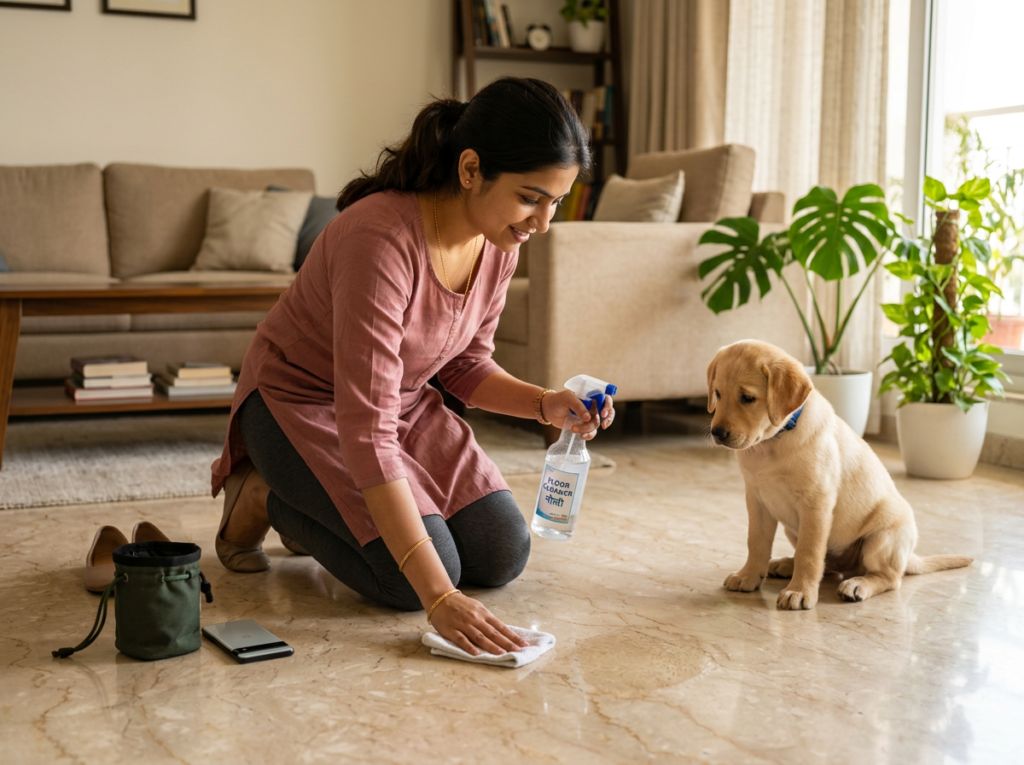
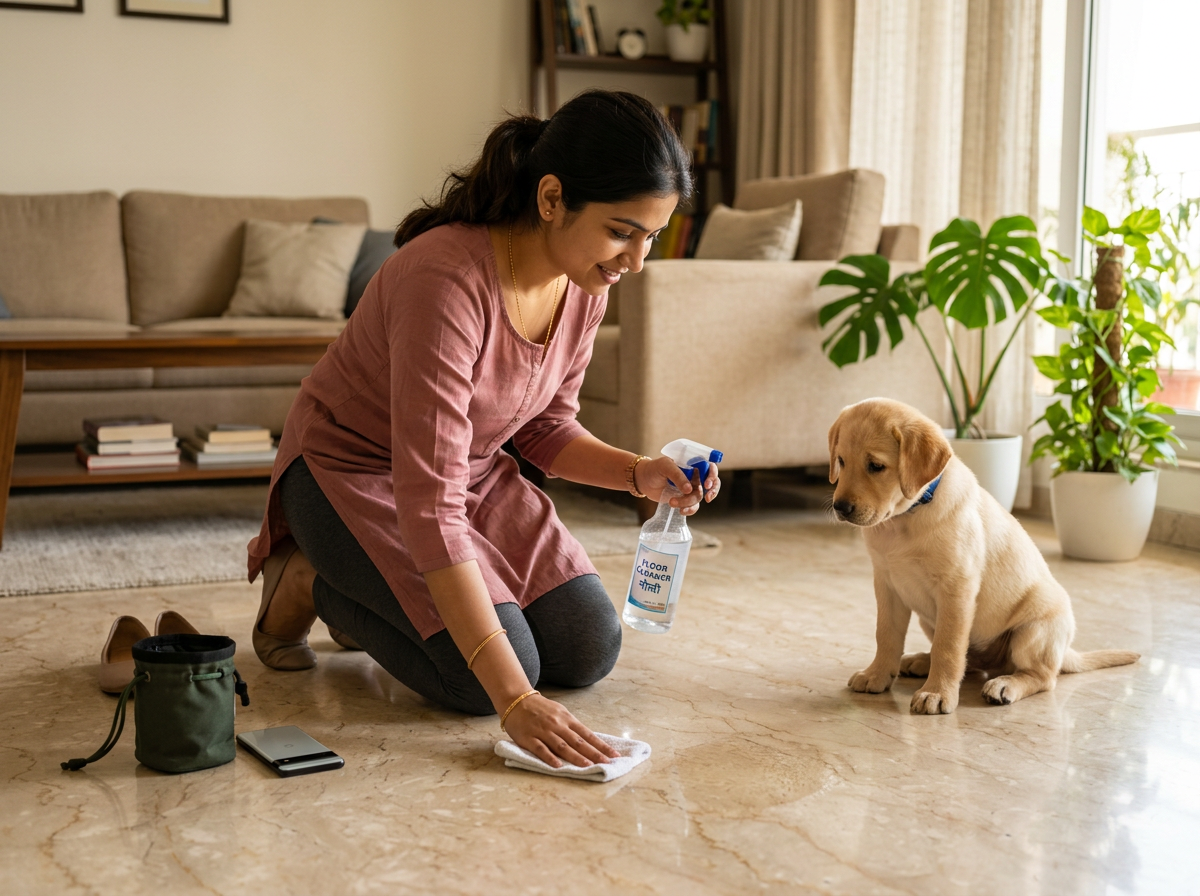
You followed the schedule. You rewarded the outdoor trips. You cleaned up the accidents without scolding. And your puppy is still peeing inside.
I hear this from Indian pet parents every single week. And the answer is almost never ‘your puppy is untrainable’ or ‘the method doesn’t work.’ It’s almost always one of six specific, identifiable, fixable reasons — and once you know which one applies to your puppy, the fix is usually quick.
This blog is the troubleshooting guide for when potty training has stalled. We’ll go through each reason specifically, how to identify it, and exactly what to do about it. Before we get to the reasons, here’s a quick diagnostic reference for common accident patterns:
| What You’re Seeing | Most Likely Reason | First Action |
| Accidents at consistent times of day | Schedule gap at that time slot | Add a toilet trip 15 minutes before the typical accident window |
| Goes outside but also goes inside soon after | Not fully emptying outside OR reward timing off | Wait longer at the outdoor spot; increase the reward immediately after outdoor success |
| Accidents only in one specific spot | Scent memory — they’ve toileted there before and the spot wasn’t fully cleaned | Deep clean with enzyme cleaner; block access for 2 weeks |
| Accidents only when unsupervised in a room | Too much freedom too soon — no bathroom signal yet established | Restrict freedom to one room; expand access as reliability increases |
| Accidents after previously being reliable | Check: schedule changed? New person in house? Medical issue? Stress event? | Rule out medical first (Section 4), then address schedule/environment change |
| Dribbling constantly, squatting frequently with small amounts | Medical — possible UTI or bladder issue | Vet visit required. This is not a training problem. |
| Only indoors, never outside despite outdoor access | Surface preference problem — see Section 5 | Surface desensitisation programme — introduce preferred surface outdoors |
| Specific to arrival of guests or new experiences | Excitement or stress urination — see Section 6 | Excitement urination protocol — do not punish, manage the trigger |
Reason 1: The Schedule Is Inconsistent — The Most Common Cause by Far
| The Schedule Gap Problem Most puppy accidents are not a training failure. They are a scheduling gap. Identify yours. |
If I asked every Indian pet parent whose puppy is still having accidents to honestly describe their toilet schedule, the most common answer would be: ‘We try to take them regularly, but sometimes we forget or it’s not always the same time.’
That ‘sometimes we forget’ is where the accidents live. The puppy is not peeing inside because they don’t understand the training — they are peeing inside because the schedule gap coincided with a full bladder and no human nearby to take them.
Here are the six most common schedule inconsistencies in Indian households — each of which causes persistent indoor accidents despite otherwise good intentions:
| Schedule Inconsistency | Why It Causes Accidents | The Fix |
| Waking trip sometimes skipped | The post-sleep bladder is the fullest it will be all day. Skip this trip and an accident within 5 minutes is almost guaranteed. | This is the non-negotiable trip. Before anything else — before looking at your phone, before making chai, before greeting anyone — toilet trip. Every morning. Every nap wake-up. |
| Post-meal trip delayed by more than 15 minutes | The gastrocolic reflex activates within 10–15 minutes of eating for most puppies. Waiting 20–30 minutes means the accident has already happened. | Set a phone timer when the bowl goes down. Timer rings in 10 minutes: toilet trip. The 10-minute post-meal window is the highest-accident-risk slot of the day. |
| Weekend schedule is different from weekday | The puppy’s biological clock is calibrated to their toilet schedule. A weekend sleep-in shifts the morning schedule by 1–2 hours, causing accidents in the bedroom because the puppy woke and no trip was taken. | Maintain consistent timing 7 days a week during training. Once fully trained (8+ weeks of reliability), occasional schedule variation is manageable. |
| Different family members using different intervals | In joint family households and homes with domestic help, the toilet interval between one caregiver’s last trip and the next person’s first trip can easily stretch to 3 hours without anyone realising. | A shared schedule — on paper or on a family WhatsApp group — with check-in times assigned to each person eliminates this gap. |
| Extending the interval too fast | Moving from 45-minute trips to 2-hour trips in one week, based on ‘3 good days’, is the most common premature extension mistake. | Extend the interval by 15 minutes at a time, only after 5 consecutive accident-free days at the current interval. Patience in the extension phase saves weeks of regression. |
| No trip before crate entry | A puppy that enters the crate with a partial bladder will either have a crate accident (which undoes the toilet training and creates a new crate hygiene problem) or will be awake and restless within 30 minutes. | The rule is absolute: toilet trip immediately before every crate entry, day or night. No exceptions based on ‘they just went 20 minutes ago.’ |
The Schedule Audit — Do This Today
Write down your actual toilet schedule for yesterday. Not what you intend to do — what actually happened. Note every trip and every accident with the time.
Then look for the gaps. If there was a 2.5-hour gap between trips in the morning: that’s where the accident happened. If the post-meal trip was taken 25 minutes after eating instead of 10: that’s where the accident happened. The schedule gap map tells you exactly what to fix.
| 📋 The 5-Consecutive-Day Rule |
| The standard for ‘the schedule is working’ is not ‘no accidents yesterday.’ |
| It is: 5 consecutive days without a single indoor accident. |
| Anything less than that means the schedule still has a gap. |
| Identify it. Close it. Run 5 more days. |
| When you have 5 clean days: extend the interval by 15 minutes. |
| Not 30 minutes. Not doubling. 15 minutes. |
Reason 2: You Are Not Rewarding Fast Enough After They Go in the Right Spot
This is the most subtle reason — and the one that most educated, well-intentioned pet parents make without realising it. They are rewarding. They are just rewarding the wrong thing because they are 2–3 seconds too late.
The association window for positive reinforcement in dogs is approximately 1–2 seconds after the behaviour. By the time most parents have said ‘good boy!’ pulled out the treat, and given it to the puppy — 4–6 seconds have passed. The puppy has moved away from the spot, possibly sniffed something else, possibly turned toward you.
The puppy that receives a treat 5 seconds after going outdoors is not being rewarded for going outdoors. They are being rewarded for turning back to look at you. The lesson learned is: turning and looking at the owner is good, not: going in this spot is good.
| ❌ What Most Parents Do | ✅ What to Do Instead |
| Puppy goes outside. Parent says ‘good boy!’ and starts walking home. Puppy finishes going — parent says ‘let’s go’ and walks away. Treat given when they re-enter the apartment — associated with coming inside, not with toileting outside. Verbal praise only — no food reward for outdoor toileting. Treat given after a 15–30 second delay — the association window has closed. Same level of reward for outdoor going as for any other event during the day. | Puppy starts going. Parent says the cue word ONCE (‘outside’, ‘go potty’) calmly DURING the act. Puppy finishes — in the next half second, treat appears. Not 3 seconds. Half a second. Verbal marker: ‘Yes!’ the instant they finish — before they have moved away from the spot. The treat used for outdoor toileting is the highest-value treat available. Not kibble. Jackpot reward for an outdoor success after a previously problematic session — 5–6 small treats instead of 1. The energy and enthusiasm of the reward is disproportionately high — outdoor = the best thing that happens all day. |
The Treat Pouch — India’s Most Underused Training Tool
The single most practical solution to slow reward timing: a small treat pouch clipped to your clothes or waistband during every toilet trip. The treat is accessible in under a second. You don’t need to dig through pockets or go back inside. The moment the puppy finishes — your hand is already moving.
In India, treat pouches are available on Amazon India and at pet stores in most metro cities. A small zip-lock bag in your pocket works just as well. The tool isn’t the point — the readiness is. Have the treat in your hand before the puppy starts going, if possible.
| ⚡ The Timing Rule in One Sentence |
| The treat must arrive before the puppy has moved a single step away from the spot where they just went. |
| If they’ve moved: you’re rewarding movement, not toileting. |
| Prepare the treat before the trip. Hold it. Deliver it at the finishing moment. |
| This one change — consistently applied — accelerates potty training by 1–2 weeks. |
Reason 3: Too Much Freedom Inside the Apartment Before Potty Training Is Fully Established
‘Fully trained’ feels like it should mean the puppy can go anywhere in the apartment. But in potty training terms, the puppy is only trained in the environments they have been trained in. A puppy that has never had an accident in the kitchen is not trained not to have accidents in the bedroom — they’ve just never been unsupervised in the bedroom.
Giving a puppy full apartment access before they have earned it — through weeks of demonstrated reliability — is one of the most reliable ways to extend potty training by months.
The freedom progression that actually works:
| Phase | Freedom Level | What This Looks Like in an Indian Apartment |
| Week 1–3 | Training room only | One room only, preferably a tiled room or the room closest to the toilet spot. Baby gate or closed door. Puppy is only in other rooms when directly supervised — meaning within arm’s reach. |
| Week 3–4 | Training room + adjacent area | Once 5 consecutive days without accident in the original room, add one adjacent room or corridor. Still supervised in new areas. No overnight freedom expansion. |
| Week 4–6 | Most of apartment (supervised) | Supervised access to most rooms. The puppy has not had an accident in 2+ weeks in any room they have access to. Never unsupervised in a room with carpet or fabric-covered furniture. |
| Week 6–8 | Full apartment (supervised) | Full apartment access with you watching. The puppy is now reliably going to the door, pee pad, or balcony when they need to go. True freedom begins here. |
| Week 8+ | Full unsupervised freedom | The puppy can be left alone in the full apartment without a crate or confinement area, and will either hold or go to their designated indoor spot. This is the fully trained state. |
The Indian Apartment-Specific Freedom Problem
In most Indian apartments, the living space is small enough that it feels natural — and kind — to let the puppy have access to all of it from day one. A 2BHK doesn’t feel like enough space to subdivide.
But this is exactly the freedom that produces persistent accidents. The solution is not expensive or complicated:
- A baby gate (available on Amazon India from ₹800–1500) across the bedroom door restricts access to fabric-floored rooms
- A playpen around the crate keeps the puppy in a controlled area when unsupervised
- Keeping the puppy in the room where you are — not allowing them to wander to other rooms when you are occupied
The investment in a baby gate for 6–8 weeks of training saves months of extended accidents on carpet and bedroom floors.
| 🚪 The Room Access Rule |
| A puppy earns access to a room when they have been accident-free in it for 2 consecutive weeks — under supervision. |
| Not ‘3 good days.’ Not ‘1 week.’ 2 full weeks. |
| This standard sounds strict. It is the standard that produces permanently reliable toilet training. |
| Anything less tends to produce a puppy who is reliable for a few days then regresses |
| — because the training was never fully consolidated in that space. |
Reason 4: Medical Issue — The Specific Signs That Tell You It Is Time to See the Vet
| When It Is Not a Training Problem Some persistent indoor accidents are not behavioural. These signs mean a vet visit is needed today. |
Before attributing persistent accidents to training failure or owner inconsistency, it is important to rule out medical causes. Some of these are common — UTIs in puppies occur more often than most Indian pet parents realise. Some are more serious. All of them require veterinary assessment rather than schedule adjustment.
If you see any of the following, pause the training analysis and go to a vet first:
| Sign | What It May Indicate | Action |
| Frequent squatting with small or no output | Straining to urinate — producing a few drops or nothing — indicates possible bladder infection (UTI), bladder stones, or urethral blockage. | Vet visit today. Especially if accompanied by crying or licking genitals. A blocked bladder is a medical emergency in male dogs. |
| Constant dribbling — wet patches without squatting | Ectopic ureter (a structural abnormality more common in females), sphincter weakness, or hormonal causes in spayed females. The puppy is not voluntarily urinating — they are leaking. | Vet visit. This is not a training problem and cannot be resolved with a schedule change. Medication or surgical correction is sometimes required. |
| Blood in urine | Pink, red, or cloudy urine indicates urinary tract infection, bladder stones, or injury. Non-negotiable vet visit. | Vet visit today. Photograph the urine if possible to show the vet. Do not wait. |
| Sudden regression after weeks of reliability | A previously toilet-trained puppy who suddenly begins having daily accidents may have a UTI, intestinal infection, or be experiencing pain during urination that is causing them to go anywhere rather than hold. | Rule out medical first. Vet visit to confirm before assuming a training regression. |
| Unusual odour or colour change in urine | Dark yellow, very strong-smelling, or bloody urine indicates dehydration, infection, or other urinary tract issues. Pale and very frequent indicates possible diabetes or kidney issues in older puppies. | Vet check. Note when the colour/smell changed and whether it correlates with any dietary change. |
| Excessive water consumption alongside accidents | Puppies drinking dramatically more water than usual, combined with increased urination, may indicate diabetes mellitus, kidney disease, or Cushing’s syndrome. | Vet visit. Measure water intake over 24 hours if possible and bring that number to the vet. |
UTIs in Indian Puppies — More Common Than Expected
Urinary tract infections are significantly more common in female puppies than male puppies, and more common in puppies who spend time near areas with contaminated water — open drains, puddles, and areas frequented by stray dogs.
In India, the monsoon season and post-monsoon period creates optimal conditions for UTI development in puppies who are still building outdoor exposure. The signs are subtle in early stages: slightly more frequent urination, occasional dribbling, and mild discomfort during urination that can look like reluctance to squat.
A simple urinalysis at your vet costs ₹200–500 and identifies UTIs immediately. If accidents have persisted for more than 2 weeks despite consistent schedule management: a urinalysis is worth doing before implementing more intensive training adjustments.
| 🩺 Medical Checklist Before Intensifying Training |
| If you’ve had 2 weeks of consistent schedule and still see daily accidents: run through this checklist before adding more training pressure. |
| □ Is the urine normal in colour and amount? |
| □ Is the puppy squatting normally — no straining or crying? |
| □ Is the frequency of urination within normal range for the age? |
| □ Has the puppy had recent vet contact and been cleared as healthy? |
| If any of these are uncertain: vet visit before schedule intensification. |
Reason 5: Surface Preference — Why Puppies Often Choose Tiles Over Outdoor Grass
This is the reason that surprises Indian pet parents the most — and it’s one that international guides rarely address because garden-trained puppies don’t have this problem.
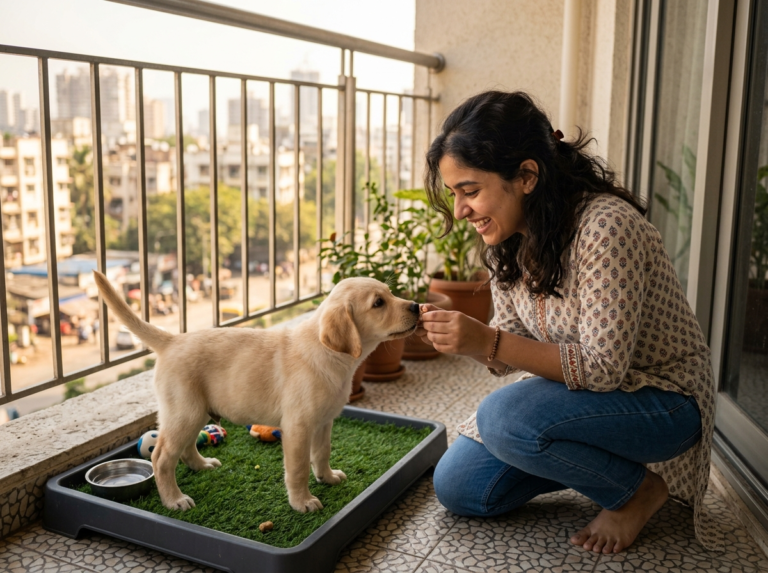
Dogs develop a strong surface preference for toileting during their early weeks. Whatever they went on most frequently during their first toilet-learning experiences becomes their preferred surface. For Indian puppies trained primarily on pee pads or bathroom tiles, the outdoor grass surface can feel genuinely foreign — and some puppies will resist using it for weeks.
If your puppy toilets readily on pee pads or bathroom tiles but seems unable or unwilling to toilet on grass or outdoor surfaces: this is a surface preference issue, not a training failure. Here is the pattern breakdown and the specific fix for each:
| Surface Pattern | Why It’s Happening | The Fix |
| Pee pad trained → goes on tile but not grass | The puppy has imprinted on a flat, soft-textured absorbent surface. Grass feels and smells completely different — almost alien compared to what they were trained on. | Bring a used pee pad to the outdoor spot. Place it on the grass. Let the puppy smell both surfaces simultaneously. Over several visits, the pee pad moves further into the grass, then is placed on the grass directly, then removed. |
| Goes on carpet or rugs but not tile | Carpet texture mimics soil — the first surface many puppies with litter or outdoor origin associate with toileting. The absorbency also feels ‘right’ in the same way soil does. | Restrict carpet access entirely until fully trained. A baby gate across carpeted rooms. Carpet scent can be long-lasting even after cleaning — deep enzyme clean + physical barrier is the solution. |
| Goes outside only on soil, won’t use balcony | The puppy has a positive outdoor soil association and rejects the balcony surface as unfamiliar. This puppy’s outdoor training is actually quite good — but needs balcony-specific desensitisation. | Bring a small amount of soil from the outdoor spot and scatter it on the balcony tray. The scent bridge helps. Spend 3–5 minutes at the balcony spot before and after each outdoor trip for 5 days. |
| Won’t toilet at all during monsoon (wet ground) | The wet surface, rain sound, and different smell of wet outdoor ground is a genuine sensory deterrent for some puppies — especially those who’ve had limited rainy-day outdoor exposure. | Pre-monsoon preparation from Week 8: deliberately walk the puppy in light rain starting from the first monsoon shower. Never force — just exposure. Rain = walk (with umbrella for the owner) so the association is normal, not negative. |
| Goes in specific corner of apartment repeatedly | This spot has a strong urine scent from previous accidents — even after surface cleaning. The puppy’s nose detects residual scent through standard cleaners and returns to the scent map. | Full enzyme cleaner treatment on that spot. After drying: place the puppy’s food bowl in that corner for 5 days. Dogs will not toilet where they eat — the food bowl breaks the toilet association with that location. |
The Scent Bridge Technique
For any surface preference problem, the scent bridge is the most effective tool:
- Take a used pee pad (one that carries the puppy’s urine scent) to the new surface.
- Place it on or near the new surface. Let the puppy sniff both.
- Wait. Most puppies, when they need to go and their scent is already on the new surface, will use it.
- The moment they do: jackpot reward. The biggest treat response you’ve given for any toilet act.
- Repeat for 5–7 sessions. By session 5, most puppies have accepted the new surface.
The scent bridge works because it creates a familiar olfactory anchor on an unfamiliar surface. The puppy smells their own scent in the new place and registers it as an established toilet spot.
| 🌱 The Food Bowl Trick for Repeat Indoor Spots |
| If the puppy keeps returning to one indoor spot despite cleaning: place their food bowl directly on that spot. |
| Dogs will not voluntarily toilet where they eat — it is a hardwired avoidance. |
| Leave the bowl there for 2 full weeks. |
| Combined with enzyme cleaner treatment, this breaks the scent memory association more effectively |
| than any other single management technique for spot-specific repetitive accidents. |
Reason 6: Excitement or Stress Urination — What It Is and How to Handle It
The puppy has been reliably trained for 2 weeks. Then a visitor arrives and they urinate at the door. Or you come home and they dribble on the floor the moment you walk in. Or you raise your voice slightly and they squat immediately.
These incidents are not potty training failures. They are a separate phenomenon — excitement or stress urination — and they require a completely different response from the standard toilet training protocol.
| 💛 Excitement Urination | 🩶 Stress / Submissive Urination |
| Trigger: Over-excitement — greeting you at the door, visitors arriving, high-energy play, anything that spikes arousal rapidly. Who gets it: Most common in puppies under 6 months. Many grow out of it naturally as sphincter control matures. Body language: Tail up or wagging, excited body, jumping — the puppy is happy, not scared. The urination is involuntary. Amount: Usually small — a dribble or small puddle at the point of maximum excitement. What makes it worse: High-energy greetings, sudden loud voices, direct eye contact and physical excitement on arrival. What helps: Low-key greetings. Come in and ignore the puppy for 30–60 seconds. No eye contact, no touching. Let the excitement peak pass before greeting. Timeline: Most puppies grow out of this by 6–9 months as bladder sphincter control matures. | Trigger: Perceived threat, correction, raised voice, or a person/dog who makes the puppy feel intimidated. Who gets it: More common in sensitive breeds and puppies from difficult early environments. Indie dogs with uncertain early history may show this. Body language: Low body posture, tail tucked, ears flat, avoiding direct eye contact. The puppy may roll onto their back as part of the submission display. Amount: Can be a larger amount than excitement urination — sometimes a full bladder release. What makes it worse: Physical punishment, loud scolding, looming body posture over the puppy. What helps: No punishment for any toilet accident — ever. Calm body language. Build confidence through positive training. The submissive signal reduces as the puppy feels safer. Important: Do not punish either type. Punishment causes more stress urination — the opposite of the desired result. |
The Management Protocol for Both Types
Neither excitement nor stress urination responds to more toilet training. They require a management and confidence-building approach:
| Management Strategy | What to Do | Why It Works |
| Manage the greeting energy | Come home to your puppy as if nothing is happening. No excited voice, no rushing to them, no eye contact for the first 60 seconds. Set down your bag, change your shoes, then greet calmly. | High-energy homecoming is the most common trigger for excitement urination. The level of your greeting energy directly determines the level of their bladder control at that moment. |
| Pre-empt the trigger | If you know guests are arriving: take the puppy out for a toilet trip 10 minutes before they arrive. An empty bladder has nothing to release. This single step prevents the majority of visitor-triggered excitement accidents. | Pre-trigger toilet trips are the most practical management tool for this specific problem. |
| Brief guests on greeting protocol | Ask visitors not to crouch down and initiate high-energy greetings with the puppy. In Indian homes especially, well-meaning relatives often rush to greet the puppy with excited energy. Brief them simply: ‘Ignore him for a minute when you arrive. It helps with his training.’ | Guest cooperation is often the missing piece. Most people will comply when given a clear, brief reason. |
| Take to toilet immediately on waking | The morning wake-up excitement urination — puppy sees you and immediately urinates — is best prevented by making the first interaction of the day a purposeful move to the toilet spot, not a greeting. | Routine: enter the bedroom / open the crate → immediate move to toilet spot → no greeting until after the toilet trip. This sequencing prevents the morning excitement accident. |
| Build confidence for stress urination | For submissive urination: use only positive training methods. Never raise your voice or loom over the puppy. Physical punishment is specifically contraindicated — it directly increases the submissive urination frequency. | Submissive urination reduces as the puppy’s confidence builds. This is a training relationship issue — not a housetraining issue. |
| Accept the developmental timeline | Both types of urination in puppies under 6 months are partially developmental. The sphincter muscle genuinely has less control at 8–12 weeks than at 6 months. Some degree of patience is warranted alongside management. | Most cases of excitement urination resolve by 5–7 months as physical maturation catches up. Consistent management during this window prevents it from becoming a longer-term pattern. |
The India-Specific Excitement Urination Pattern
In Indian households — particularly with joint family living and the high-energy social culture around guests, festival visits, and family gatherings — excitement urination is more prevalent than in more contained households.
The ‘guests arriving for Diwali’ scenario is one of the most common excitement urination triggers I hear about. Ten people arriving with excitement, loud greetings, and immediate physical interaction with the puppy produces predictable excitement urination.
The solution is the same as any excitement trigger: empty bladder before the stimulus, low-energy greetings, and the visitors following a brief protocol. Most families are remarkably cooperative when the reason is explained. Keep the briefing short: ‘Let him sniff your hand first — come in calmly and ignore him for 30 seconds. It helps with his training.’
| ✅ The 6-Reason Summary |
| Reason 1: Schedule gap — audit your schedule, find the gap, close it. |
| Reason 2: Reward timing — treat must arrive in under 1 second of finishing. |
| Reason 3: Too much freedom — earn access room by room over 2 weeks. |
| Reason 4: Medical — rule out UTI or structural issue before intensifying training. |
| Reason 5: Surface preference — use the scent bridge to introduce new surfaces. |
| Reason 6: Excitement / stress — manage the trigger, don’t punish the symptom. |
| If you work through each of these systematically: the accidents will stop. |
| Not because of luck — because each reason is specific and each fix is specific. |