A Step-by-Step Guide for Indian Homes
By Harshad | Founder, Indieedogs | Puppy Training & Behaviour Specialist
Here’s something I say to almost every new Indian pet parent I work with: teaching your puppy to be alone is not a nice-to-have. It is a welfare essential.
India’s dog ownership culture is warm, attentive, and deeply loving — which is wonderful for most things and genuinely counterproductive for this one. The same quality that makes Indian pet parents excellent caregivers — always present, always responsive — is the quality that produces dogs who cannot cope when that presence is withdrawn.
The work-from-home surge, joint family households, domestic staff always around — all of these create the conditions for a puppy who never learns that being alone is normal, finite, and safe. Until the day it has to be. And by then, the tolerance that should have been built gradually is absent entirely.
This guide builds alone-time tolerance systematically — from 10 seconds to 8 hours — using a four-step progression designed specifically for Indian home environments, schedules, and the specific challenges that make alone-time training harder here than the international guides acknowledge.
1. The Difference Between Healthy Alone-Time Tolerance and Harmful Forced Isolation
Before starting the programme, it helps to understand exactly what you’re building — and what you’re not. Because the fear of ‘leaving the puppy alone’ in Indian households is often rooted in a mental image of harmful isolation, not healthy independence training.
These are genuinely different things. The distinction determines everything that follows:
| ✅ Healthy Alone-Time Tolerance | ⚠️ Harmful Forced Isolation |
| Introduced gradually, at the puppy’s pace, with positive association Durations that match the puppy’s age and developmental capacity Puppy has water, enrichment, and a safe, comfortable space Alone-time happens after adequate exercise and mental stimulation The puppy settles into rest — not sustained distress Returns are calm and matter-of-fact — not emotionally charged Duration increases only once the puppy is comfortable at the current level The puppy chooses their rest spot voluntarily and independently Result: confident, settled adult dog with healthy independence | Puppy placed in a space without preparation or positive association Duration exceeds the puppy’s physical or emotional capacity No enrichment, no water, no comfortable rest space available Alone-time used as a solution to inconvenience rather than a teaching tool Puppy remains in continuous distress for the duration Returns are highly emotional — reinforcing that departure was a significant event Duration jumps suddenly from very little to many hours Puppy paces, cries, or becomes destructive rather than resting Result: sensitised anxiety response, developed separation distress |
The Indian Context: Why This Matters More Here
In India, the pendulum swings between two extremes: either constant presence that never allows alone-time development, or — when work demands force the issue — sudden 8-hour absences that feel like abandonment to an unprepared dog.
The programme in this blog is the middle path: deliberate, graduated, positive alone-time built consistently over 6–8 weeks, producing a dog that is genuinely comfortable across the range of alone-time your life actually requires.
The key phrase is genuinely comfortable. Not tolerating with distress. Not habituated to misery. Actually settled, resting, and untroubled.
| 🎯 The Goal in One Sentence |
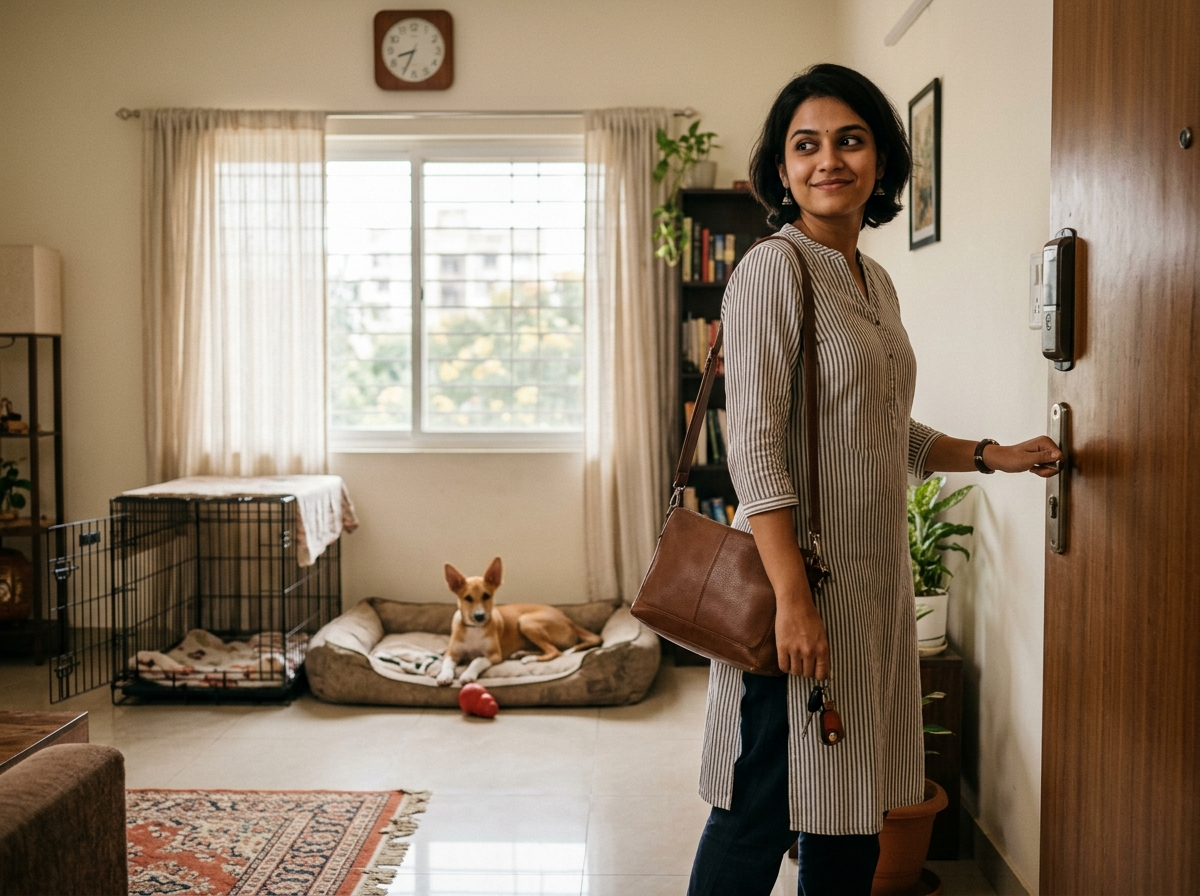
| A dog that, when you leave, gives a brief look at the door, finds their bed, lies down, and goes to sleep. |
| Not resigned. Not distressed. Settled. |
| That outcome is achievable for almost every dog — with the right programme, started at the right time. |
| This guide is that programme. |
2. Step 1: Baby Steps — From 10 Seconds to 2 Minutes in Week 1
| Step 1: Movement Desensitisation Teaching the puppy that human movement is not departure — before any door is involved. |
Most alone-time guides jump straight to ‘leave the apartment for 5 minutes.’ This misses the most important foundation: many Indian puppies have never been left alone in any context, even within the same room. The programme starts there.
Week 1 is entirely within the apartment. The front door is not involved. The goal is building the fundamental association: your movement is normal, your absence is temporary, and calm non-following is rewarded.
| Day | Duration | What to Do | Why This Specifically |
| Day 1 | 10 seconds | Stand up. Walk to the other end of the room. Return. Treat the puppy for staying calm without following. Repeat 10 times through the day. | Teaching: human movement is not a departure. Many Indian puppies who’ve never been alone will follow every single movement. This is the first lesson that movement does not mean departure. |
| Day 2 | 30 seconds | Walk to a different area of the room. Do something — check your phone, stand at the window. Return after 30 seconds. Treat calm, non-following behaviour. | Extending duration. The puppy begins to register that movement is normal and does not require following. Reward the settled behaviour, not the return. |
| Day 3 | 1 minute | Walk to the edge of the room near the doorway — but do not go through. Stay visible. Come back after 1 minute. If the puppy followed: no reaction, just try again with a shorter duration. | Introducing proximity to the door without crossing it. The doorway is the highest-anxiety point — approaching it gradually prevents it becoming a trigger. |
| Day 4 | 2 minutes | Give the puppy a Kong or chew toy. Walk to the doorway area. Stay for 2 minutes while they work on the Kong. Return before they finish it. | Enrichment + distance together. The Kong occupies the puppy during the separation, and your return happens before the Kong runs out — teaching: you come back before the good things end. |
| Day 5 | 2 min + vary | Run 5 sessions of varying length: 30 seconds, 2 minutes, 45 seconds, 2 minutes, 1 minute. The variability prevents the puppy from clock-watching. | Variable duration is important throughout the programme. A dog who learns ‘2 minutes = owner comes back’ clock-watches at the 2-minute mark. Unpredictability prevents this pattern. |
What to Do When the Puppy Follows
Most puppies will follow you initially. This is completely expected and not a problem. Here’s how to handle it without turning it into a confrontation:
- Do not push the puppy away or physically redirect them. Simply turn around, walk back to your start position, wait 10 seconds, and try again with a slightly shorter duration.
- If the puppy follows on every single attempt for 3+ sessions: you are moving too fast. Stay in the same room at a shorter distance until they stay independently, then add distance gradually.
- Never scold or express frustration when the puppy follows. It is not defiance — it is attachment. The training teaches the alternative. Patience is the tool.
The Enrichment Setup for Step 1
From Day 1, every alone-time session — even the 10-second ones — should begin with the puppy having something to do. This could be a Kong, a scatter feed, a chew, or a sniff toy. The enrichment does two things: it occupies the puppy during the brief absence, and it builds the association between your departure and something positive appearing.
A full India-specific enrichment guide is in the table below — consult it before starting Step 1 and keep options rotated across the week.
| Enrichment Option | What to Do — India Specific | Why It Helps During Alone-Time |
| Frozen Kong / lick mat | Stuff a Kong with peanut butter (no xylitol), wet food, or mashed banana. Freeze overnight. Give at crate entry for departures. In India: mashed dal + kibble or plain curd also work well in a Kong. | The frozen version lasts 15–25 minutes — exactly the window when alone-time protest is most likely. It occupies the puppy through the highest-anxiety departure period. |
| Scatter feeding | Instead of feeding from a bowl, scatter the meal across a sniff mat, in the garden (if available), or across the kitchen floor. The puppy spends 10–15 minutes sniffing out every piece. | 10–15 minutes of scatter feeding produces a calm, naturally tired puppy. Sniffing is neurologically exhausting in the best way — the equivalent of a 30-minute walk for the brain. |
| Ice blocks with kibble | Freeze kibble or small treats inside a block of ice in a steel katori. Give to the puppy during alone sessions in summer months especially. | The cold sensation, the challenge, and the duration (15–20 minutes to work through) combine to produce prolonged, calm engagement during alone-time. Particularly valuable in Indian summers. |
| Chew options in India | Bully sticks and yak chews (available on Amazon India). Raw carrots — available everywhere, free, safe, and very effective. Raw bones (supervised only). Dehydrated sweet potato strips. | Long-duration chews give the puppy something to do that outlasts the departure anxiety window. The chewing motion itself produces a calming neurological effect through serotonin release. |
| Sniff box | Take a cardboard box. Put 20–30 small treat pieces inside, crumple newspaper over them, close the top loosely. The puppy pushes the box around, tips it, digs into it to find the treats. | The sniff box is free to make, endlessly variable, and occupies a puppy for 10–20 minutes. Particularly good for the first-thing-in-the-morning alone session when the puppy is fresh and motivated. |
| White noise / radio | A radio on low volume tuned to a talk station (not music with sudden loud sections). Or a white noise app set to ‘fan sounds’ or ‘rain.’ Placed near the crate at a low-but-audible level. | Ambient sound reduces the abrupt silence that many Indian apartment puppies find alarming when left alone. It also masks the intermittent building sounds (lifts, neighbours, delivery knocks) that can trigger barking. |
3. Step 2: Out of Sight — Leaving the Room While Staying in the House
| Step 2: Disappearance Practice Out of sight is categorically different from out of the room. This step bridges that gap. |
Going from ‘visible across the room’ to ‘disappeared through a doorway’ is one of the most significant transitions in alone-time training. Many puppies who tolerate 5 minutes visible will panic at 30 seconds invisible. This step builds that gap systematically.
Step 2 begins on Day 6 — only if the puppy is consistently calm at the 2-minute same-room distance from Day 5. If Day 5 was not calm: spend one extra day on Step 1 before crossing the doorway.
| Day | Duration | What to Do | Why This Step |
| Day 6 | 30 sec OOS | Walk through the doorway into the corridor, bathroom, or kitchen. Out of sight. Return within 30 seconds. Calm return — no emotional greeting, no ‘good boy/girl’ at the door. | First true out-of-sight moment. The puppy cannot see you. This is categorically different from same-room distance. Many puppies who tolerated 2 minutes visible will react to 30 seconds invisible. |
| Day 7 | 1 min OOS | Same as Day 6 but extend to 60 seconds. Give a Kong before leaving the room. Return before the Kong is finished. Normal behaviour — do not re-enter if the puppy vocalises. Wait for a 3-second quiet window. | The return rule: only return to calm behaviour, not to noise. This one rule prevents the most common out-of-sight training mistake — teaching that barking brings you back. |
| Day 8 | 3 min OOS | Leave the room. Do something in the other room — make chai, work briefly at a desk, fold laundry. Return after 3 minutes. Treat quiet, settled behaviour on return. | You are doing real things in another room. This normalises your absence as ordinary household activity — not a departure event. |
| Day 9 | 5 min OOS | Give the puppy a Kong. Leave the room. Close the door to that room (if your layout allows) or simply be in a part of the apartment with a natural barrier. Return at 5 minutes. | Optional door between rooms introduces mild barrier — similar to what the puppy will experience during full departures. Introduce this only if 5 minutes with no barrier was calm. |
| Day 10 | 10 min OOS | Nap crating opportunity: if the puppy is tired after their morning walk, place them in the crate and leave the room. Return when they stir or after 10 minutes, whichever comes first. | Pairing natural tiredness with the out-of-sight training produces the smoothest experience. A tired puppy in a crate in the next room is the closest simulation of a real departure. |
| Day 11 | 15–20 min | Multiple sessions at varying lengths: 5 min, 15 min, 8 min, 20 min. Do real activities. Include a nap crating session if natural tiredness allows. | By Day 11, the puppy should be tolerating 15–20 minutes out-of-sight without sustained distress. This is the foundation for the short outdoor departures that follow. |
The Return Rule — Non-Negotiable
Across all out-of-sight sessions, one rule overrides everything else: return to calm behaviour, never to vocalising behaviour.
This means: if the puppy is barking when you are about to re-enter the room — wait. Stand outside the door. Wait for a 3-second window of quiet. Then re-enter calmly. This takes longer in the moment. It pays dividends for the next 15 years.
The single most common mistake at this stage: hearing barking and rushing in because the neighbour might complain. I understand the pressure. But entering during barking teaches one clean lesson: barking brings the owner back. That lesson is very hard to undo once established.
Wait for quiet. Even 3 seconds. Then enter, treat, proceed.
| 📹 Use the Camera at Every Step 2 Session |
| The camera is your most important tool in Step 2. |
| Set it up before every out-of-sight session — even 5-minute ones. |
| Review the footage. Note: when did the puppy settle? Did they check the door once and lie down? |
| Or were they pacing the whole time? |
| The footage tells you whether you are building confidence or masking distress. |
| Build confidence. Never mask distress. |
4. Step 3: Out of the House — First Short Departures and Handling Initial Protests
| Step 3: Real Departures Begin The apartment door closes. The puppy is genuinely alone for the first time. Here is how to do it right. |
Step 3 begins on Day 12 — only when the puppy is consistently holding 15–20 minutes out-of-sight within the apartment. That daytime foundation is the prerequisite. Starting Step 3 before it is established produces the most common failure pattern: a puppy that tolerates being in the next room but panics the moment the front door closes.
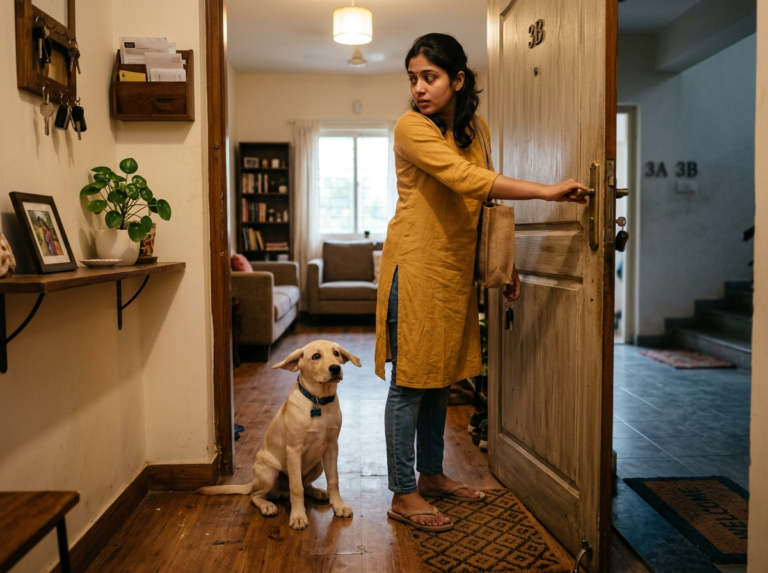
The front door is a significant new stimulus. It sounds different. It smells different. It comes with a different set of preceding sounds — shoes being put on, keys being picked up, a bag being gathered. The pre-departure ritual desensitisation that runs alongside Step 3 addresses this directly.
| Days | Duration | What to Do | The Milestone |
| Days 12–13 | 2–5 min | Step outside the apartment door. Stand in the corridor/stairwell for 2–3 minutes. Come back in. Camera running. Review footage — was the puppy sub-threshold throughout? | First real outdoor departure. The apartment door closing is a significant new stimulus. 2–3 minutes initially is intentionally short — you want the return to happen before any distress reaches full panic. |
| Days 14–15 | 5–10 min | Short building departure: go down to the ground floor, check the post, speak to the security guard, come back. 5–10 minutes total. Camera confirms sub-threshold. | A genuine trip outside the building — not just the corridor. The puppy hears the lift, the building sounds, the ambient noise of you being genuinely elsewhere. |
| Days 16–17 | 15–20 min | A short nearby errand: 15 minutes to a local shop and back. Or a walk around the block. Real absence with a defined, short end point. Camera check on return. | Real-world departure length beginning. Each return — to a camera showing a settled or recovering dog — is evidence that the programme is working. |
| Days 18–19 | 30 min | 30-minute absence. Go to a chai stall, a park, run a short errand. Pre-departure: play session + toilet trip + Kong in crate. Return to calm dog. This is the first major milestone. | The 30-minute mark is significant: it represents the full deployment of everything learned in Steps 1–3. Many dogs who reach Day 18 settled are ready for the building-up phase in Step 4. |
| Days 20–21 | Vary 10–45 min | Run departures of varying lengths across both days: 10 min, 45 min, 20 min, 30 min, 15 min. No two in a row of the same length. End the week here before progressing to Step 4. | Variability consolidates the learning. A dog that has experienced 10 minutes and 45 minutes learns that departure length is unpredictable — and that all of them end with a return. |
Handling Initial Protests on First Real Departures
Some degree of vocalising on the first outdoor departure is expected and normal. Here is how to handle it:
- Do not immediately re-enter when you hear protest. Stand at the corridor for 60–90 seconds after the first vocalisation. If it settles: this is normal adjustment. If it escalates to sustained panic: re-enter calmly, no drama, and treat this session as ‘too long’ — shorten the next departure.
- Consult the camera footage from inside before you make any decision. Hear protest does not tell you as much as see what the puppy is doing. Vocalising while pacing is different from one bark then lying down.
- The first outdoor departures should always be preceded by the pre-departure routine below. Skipping it significantly increases the chance of protest.
The Pre-Departure Routine — Used from Step 3 Onward for Every Departure
This routine is used before every departure from Step 3 through the end of the programme — and ideally, for the life of the dog. It takes approximately 45 minutes to run and produces measurably better alone-time outcomes than departures without it.
| Timing | Step | What to Do | Why It Matters |
| 45 min | Exercise | A proper physical exercise session: 20–30 minute walk or active play in the compound. Not a toilet trip — actual exercise. | A tired dog rests. The correlation between pre-departure exercise and alone-time quality is direct and documented. Skip this and alone-time is harder every time. |
| 30 min | Toilet trip | After exercise: full toilet opportunity. Wait until they go — do not rush. A puppy that has emptied before being alone is significantly more comfortable. | Bladder discomfort during alone-time is a primary cause of restlessness and vocalisation. This step is as important as exercise. |
| 20 min | Calm-down | 10–15 minutes of calm settling. The puppy eats, drinks water, and naturally calms from the exercise session. No high-energy play. | Arousal from exercise needs to settle before crate entry. A still-aroused puppy put into a crate stays restless for longer. |
| 10 min | Enrichment prep | Give the frozen Kong, scatter feed, or chew. The puppy begins working on it. Let them be occupied for 3–5 minutes before crate entry — so crate entry is not the first moment with the enrichment. | If the Kong appears only at crate entry, the crate becomes a Kong-predictor — helpful but less reliable than if Kong time is the general departure association regardless of the crate. |
| 5 min | Crate entry | Calm crate word. Final treat toss inside. Door closes. Brief ‘good dog.’ Matter-of-fact departure. No extended goodbye. | Routine energy = departure energy. A calm, brief entry produces a calmer first 10 minutes alone than an emotional one. |
| 0 min | Camera check | Glance at the camera app on your phone after 5 minutes of being outside. Note: settled and resting, or still pacing? This is your real-time feedback on whether the programme is progressing. | The camera is your only accurate feedback during the departure. Subjective assessment on return is insufficient — by then, the puppy has reset. The footage tells you what actually happened. |
5. Step 4: Building to a Full 8-Hour Working Day Over 6–8 Weeks
By the end of Step 3 (around Day 21), most puppies are comfortable with 30–45 minute departures. Step 4 builds from there to the full working day — week by week, with a mid-day break arrangement that makes the full day achievable without asking more than the puppy’s developmental stage allows.
| Phase | Target | What to Do | Key Milestone |
| Wk 3 | 30–60 min | Consolidate the 30-minute comfortable departure. Add 45-minute and 60-minute departures. Run at least one departure daily. Pre-departure routine every time without exception. | The 60-minute milestone. A dog comfortably alone for 1 hour is ready for the next doubling. |
| Wk 4 | 1–2 hours | Build to 90 minutes, then 2 hours. A dog walker, trusted neighbour, or building staff member can begin their introductory visits this week — getting used to the dog before they are needed. | 2 hours is the functional daytime threshold for most Indian working households. Reach this before attempting longer. |
| Wk 5 | 2–3 hours | Introduce the mid-day check arrangement: dog walker or family member visits at the 2-hour mark, brief 15-minute engagement, leaves. The puppy is alone again for the second window. Camera throughout. | The mid-day break model begins. This is the realistic management for most Indian working households with dogs under 6 months. |
| Wk 6 | 3–4 hours | The window between arrival and mid-day check extends to 3 hours, then 4. Monitor using camera. The pre-departure routine is now second nature — both for you and the puppy. | 3–4 hours alone before mid-day break is achievable by Week 6 for most puppies who have been through the full Steps 1–3 programme. |
| Wk 7 | 4–6 hours | Begin testing single longer windows on days where you can arrange a return at 4 then 6 hours. Camera confirms sub-threshold throughout. Dog walker continues mid-day visits. | The 6-hour milestone: the longest single alone-window most Indian apartments need. Important: do not jump from 4 to 8 hours. 6 hours first, consolidated over multiple successful sessions. |
| Wk 8 | 6–8 hours | Full working-day departures begin. Dog walker or neighbour at mid-day (hour 4–5 of the day). Second window of 3–4 hours. Total alone time 7–8 hours with mid-day break. | The functional working day. Most Indian pet parents reach this with a mid-day break arrangement rather than a single 8-hour window — which is appropriate and kind for a dog of any age. |
| Wk 9+ | Maintain | Daily alone-time sessions continue even on WFH days and weekends. One 20–30 minute session minimum, every day. This is the maintenance dose for the lifetime of the dog. | The most common relapse: a period of constant togetherness (extended leave, WFH, school holidays) resets the baseline. Daily alone-time prevents regression regardless of your schedule. |
| Any Wk | Regression | If distress returns at a previously comfortable level: go back 2 steps, not 1. Re-run that stage for 3 days before progressing. Regression is information — it means the step was too large or the gap between sessions was too long. | Regression is normal and common. It does not mean failure. It means: recalibrate one step back and rebuild from there. The second time through is always faster. |
The Mid-Day Break Model for Indian Households
A full 8-hour alone window is not biologically appropriate for a puppy under 12 months — and is significantly more comfortable for adult dogs when broken at the midpoint. The mid-day break model is the realistic framework for Indian working pet parents:
- Morning window: 8am departure → dog walker or neighbour check at 12–1pm (4–5 hours)
- Mid-day visit: 15–20 minutes of engagement, toilet, brief play, then departure again
- Afternoon window: 1pm → return home at 5–6pm (4–5 hours)
- Total alone time: approximately 8 hours, with a mid-day break that resets the biological clock
Who provides the mid-day visit in Indian households:
- A trusted neighbour or building resident who has been introduced to the dog during the training period
- A professional dog walker — increasingly available in Indian metros through platforms like PetBacker, DoggyWorld, and local trainer networks
- A family member who works nearby or has a flexible schedule
- A building security guard or maintenance staff member (with their prior agreement and the building management’s awareness)
India-Specific Challenges in Step 4
The 6–8 week alone-time build surfaces specific Indian household challenges. Here is how to handle the most common ones:
| India-Specific Challenge | Why It Disrupts the Programme | The Solution |
| WFH and hybrid work schedules | The puppy is used to you being home all day. On office days, the sudden 8-hour absence triggers extreme distress — even in a puppy that seemed fine at home. | Run the programme regardless of WFH status. Create at least 1 daily deliberate alone-time window even when working from home. Go to a cafe for 30 minutes, step out for an errand. The daily practice prevents the office-day shock. |
| Joint family — too many people always home | Someone is always present. The puppy never learns to be alone because there is no opportunity. The one day everyone is out becomes a crisis. | Build the alone-time programme with the primary attachment person, not a secondary family member. The puppy bonded to one person needs to experience that person’s absence — not just any person’s. Schedule intentional alone windows regularly. |
| Housing society restrictions on outdoor space | Many Indian housing societies have restricted pet access to outdoor areas, making the transition from indoor out-of-sight practice to outdoor departures feel like a large jump. | The corridor and stairwell outside your apartment serve as the transitional outdoor space. Steps 12–15 of this programme work perfectly in your building’s common areas before any society-facing outdoor departure is required. |
| Domestic help arriving during alone sessions | The cook arriving at 9am lets the puppy out of the crate ‘because they were crying.’ The programme is disrupted. The puppy learns: making noise at 9am produces the cook. | Brief conversation: ‘Please do not let the puppy out if he’s in the crate and crying. If he needs the toilet, please call me first.’ Put a note on the crate door during training phases if needed. The cook can interact with the puppy after the training session has ended. |
| Neighbours complaining about barking | In Indian apartment buildings, barking during alone-time training can produce complaints from neighbours — adding pressure that leads owners to give up the programme before results appear. | Honest conversation with immediate neighbours: ‘We are training our puppy for alone-time — it will be noisy for 1–2 weeks and then should resolve. I wanted to let you know in advance.’ Most neighbours respect this. Provide a timeline. Keep it. |
| Summer heat limiting daytime outdoor sessions | In May–June across most of India, morning walks are done by 7am — leaving long stretches of indoor time that the puppy struggles to fill calmly. | Summer is actually an excellent alone-time training window: the puppy is naturally less active in the heat and more inclined to rest. Use cool early morning sessions for exercise, then alone-time crate sessions in the cooler afternoon with a fan directed near the crate. |
The Milestones That Confirm the Programme Is Working
Watch for these specific markers across the 6–8 weeks:
- Week 3: Camera shows dog settling within 10 minutes of departure consistently
- Week 4: Pre-departure ritual no longer triggers anxiety — keys and shoes are neutral
- Week 5: Dog goes voluntarily to crate or bed as you prepare to leave
- Week 6: Dog walker reports puppy is settled on arrival (not still pacing from hours earlier)
- Week 7: Camera at 90 minutes shows dog asleep or resting, not alert or anxious
- Week 8: First full working day with mid-day break — camera confirms settled in both windows
Each of these is a real, measurable improvement in the dog’s neurological stress response to being alone. They are not signs that the dog has ‘given up.’ They are signs that the programme has succeeded.