The Positive Method — From First Introduction to Overnight
By Harshad | Founder, Indieedogs | Puppy Training & Behaviour Specialist
Ask most Indian pet parents about crate training and you’ll get one of two reactions: either ‘isn’t that cruel?’ or ‘we tried it but the puppy cried so much we just gave up.’ Both reactions are understandable. And both lead to the same outcome — a dog without a safe space of their own, and an owner without the management tool that makes the first year significantly easier.
Done the wrong way — forcing a puppy into a crate and closing the door — crate training is uncomfortable for everyone and produces lasting crate aversion. Done the positive way — gradually, in your own language, at the puppy’s pace — a crate becomes the dog’s voluntary retreat. A place they go when overwhelmed, when tired, when the world is too much.
This blog gives you the complete positive method: five steps, a day-by-day 2-week plan, and the overnight routine that brings everything together. No force. No flooding. Just gradual, trust-based introduction that produces a dog who sees their crate as home.
1. Why Crate Training Is Completely Humane When Done Correctly
Before we get into the how, let’s address the why — because in India especially, crate training carries a stigma that keeps many pet parents from even trying it. That stigma comes from a misunderstanding of what the crate is and what dogs are.
| ❌ The Myth: Crates Are Cruel | ✅ The Reality: Positive Crate Training |
| Putting a dog in a box is a punishment. Wild dogs don’t sleep in enclosed spaces. The puppy will feel trapped and afraid. It’s lazy training — avoiding the real work. Crate-trained dogs are more anxious than non-crated dogs. It’s a Western trend that doesn’t suit Indian dogs. | Dogs are den animals by evolutionary heritage — enclosed, covered spaces trigger calm, not panic. Wild canines absolutely use dens — for safety, whelping, and rest. The crate replicates this instinct. A gradually introduced crate is a source of security, not fear. The puppy’s body language tells you which it is. A crate-trained dog can be safely transported, hospitalised, and managed in emergency situations — critical welfare skills. Research shows crate-trained dogs show lower separation anxiety when the crate is introduced positively. Indian dogs — especially Indie dogs — respond excellently to crate training as a den equivalent. |
The One Condition That Makes Crate Training Humane
There is one condition under which a crate is entirely humane: it is introduced gradually, positively, and the puppy is never locked in longer than their physical and developmental needs allow.
For an 8-week puppy: maximum 2 hours during the day (excluding sleep), with overnight being a separate protocol (see Section 5 and the Night 1 blog). This duration increases with age — a 6-month-old can manage 3–4 hours. An adult dog can sleep in a crate overnight indefinitely if the crate has been their space since puppyhood.
- 8 weeks: 1.5–2 hours maximum daytime (plus naps and overnight)
- 12 weeks: 2–3 hours maximum daytime
- 5–6 months: 3–4 hours maximum daytime
- Adult: 4–6 hours maximum daytime — overnight is separate
| 🐾 The Crate Is Not a Punishment |
| This bears repeating because it shapes everything that follows. |
| The crate is never used as a punishment. Never put the puppy in as a response to bad behaviour. |
| The crate is their space — chosen, positive, voluntary. |
| The moment you use it as a penalty, it stops being a safe space and becomes a consequence. |
| That association is very difficult to undo. |
2. Step 1: Introduction — Making the Crate Appealing Before the Door Closes
| Step 1: The Association Phase The door never closes in Step 1. The goal is one thing only: the crate becomes a place the puppy chooses. |
The single most common mistake in crate training is rushing to close the door. The door is the last thing that closes. Everything that comes before it is the actual work — building an association between the crate and every good thing the puppy knows.
Step 1 takes 1–2 days. Do not skip it regardless of how eager you are to progress. The difference between a dog that goes into the crate voluntarily and one that has to be placed inside is entirely determined by whether Step 1 was done properly.
| Introduction Activity | What to Do | Why This Specifically |
| Place the crate, leave it open | Set the crate up in the room where the puppy spends most of their time. Door open. No attempts to put the puppy inside. Just let them investigate it at will. | The crate should first register as part of the environment — not as something that happens to them. Allow 12–24 hours of this before the next step. |
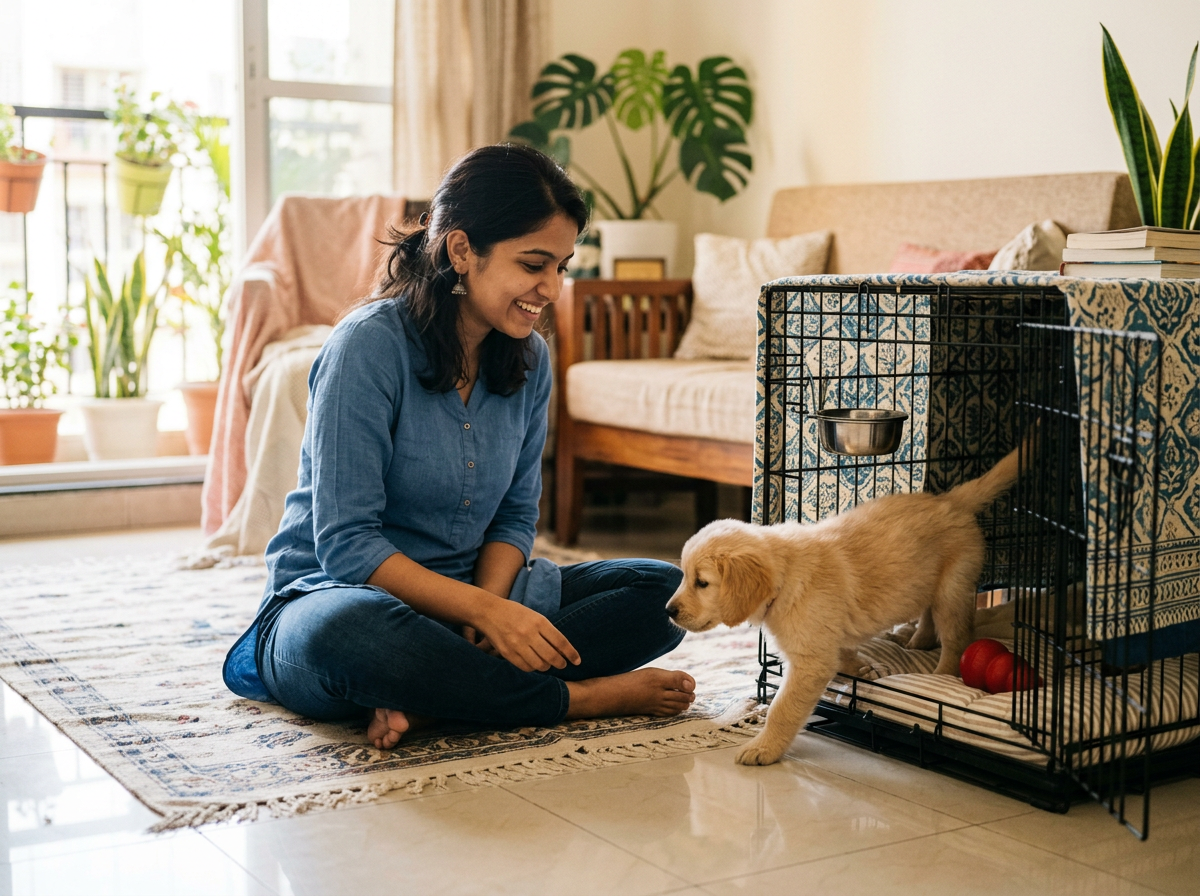
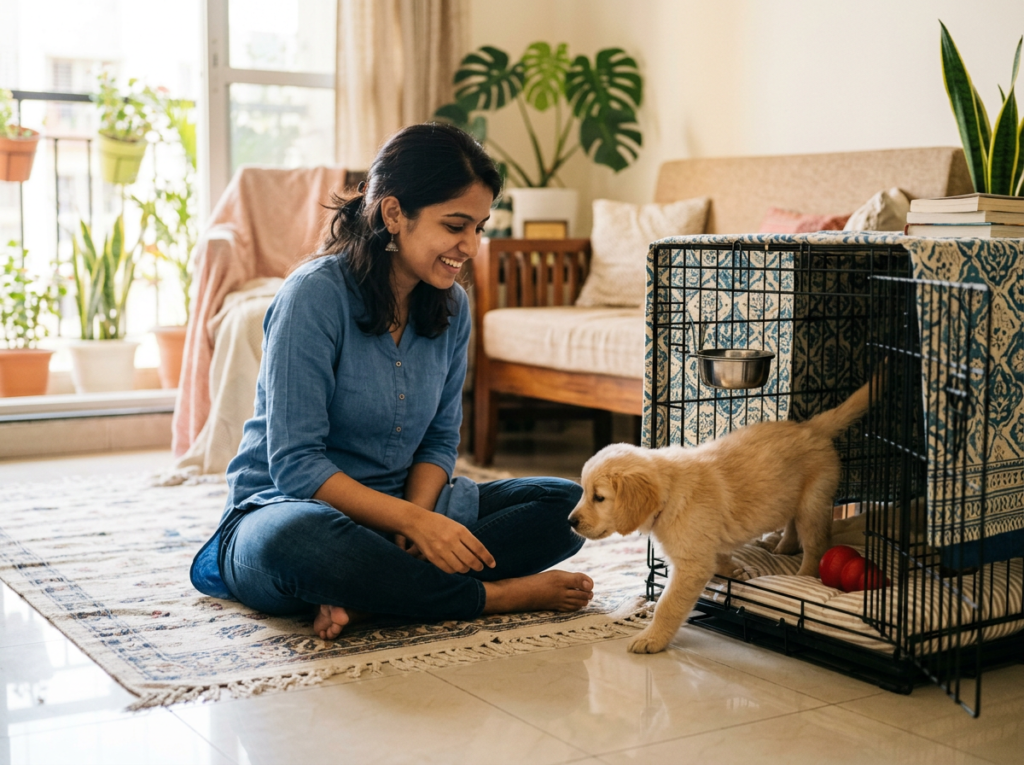
| Scatter treats near and inside | Toss 3–4 small treats near the crate entrance. Later, toss treats just inside — not deep inside. Let the puppy go in and come straight back out. | Voluntary entry is the goal at this stage. Every time the puppy chooses to go in, even partially, a treat follows. The crate entrance becomes a rewarding location. |
| Feed one meal inside the crate | Place the food bowl just inside the crate entrance. As the puppy becomes comfortable, move the bowl slightly further in over successive meals. | Mealtime is the most positive event in a puppy’s day. Associating it with crate proximity is the fastest way to build positive crate emotion. |
| Place worn clothing inside | Put a t-shirt or cotton item you have worn inside the crate. Do not wash it first — the scent is the point. | Your scent is the most comforting thing available to an 8-week-old puppy. Making the crate smell like you makes it smell like safety. |
| Introduce a crate word | Begin using a calm, positive word each time the puppy moves toward or enters the crate: ‘bed’, ‘crate’, or ‘home’ — whatever you’ll use consistently. | The word becomes a cue. Within a week of consistent use, many puppies will move toward the crate when they hear it. This cue is enormously useful for the rest of the dog’s life. |
Body Language Cues to Watch in Step 1
Your puppy’s body language tells you whether Step 1 is working. What you want to see:
- Voluntary approach to the crate without any prompting from you
- Relaxed body posture when near the crate — loose tail, soft eyes, weight even
- Eating comfortably from a bowl placed at the crate entrance
- Occasionally going inside the crate unprompted and coming back out calmly
What tells you Step 1 needs more time: the puppy approaches the crate with a crouched posture, stiff body, or wide eyes. If you see this, spend another day on Step 1 before progressing. There is no timeline more important than the puppy’s comfort level.
| ⏰ The Step 1 Timeline |
| Most puppies are ready for Step 2 within 24–48 hours of the crate arriving. |
| Some sensitive puppies need 3–4 days. That is fine. |
| The marker for readiness: the puppy goes in and out of the crate voluntarily |
| without any prompting from you, several times per day. |
| That is the only readiness signal that matters. |
3. Step 2: Short Sessions — Building Comfort With Door Open, Then Briefly Closed
Once the puppy is voluntarily entering the crate, you begin introducing the door — first as a moving object, then as a brief barrier. The progression from open to 5 seconds to 15 seconds to 30 seconds is gradual because the goal is zero distress at every stage.
Run 3–4 short sessions per day during Step 2. Each session is 5–10 minutes maximum. You are not trying to increase duration yet — you are building door confidence.
| Session | Door State | What to Do | Why This Step |
| Session 1 | Door open | Toss treat inside. Puppy goes in. Puppy comes out. Treat on exit. Repeat 5 times. No door movement yet. | Building voluntary entry. The puppy controls exit — always. |
| Session 2 | Door open | Same as Session 1 but stay slightly longer before exiting each time. Treat for any hesitation inside. Still no door movement. | Increasing dwell time voluntarily. The puppy decides when to leave — you reward staying. |
| Session 3 | Door touch | Puppy goes in. Gently touch the door — do not close. Treat. Puppy exits. Repeat. The door moves but does not close. | Desensitising the door movement before it becomes a barrier. Many anxiety responses are triggered by the door, not the crate itself. |
| Session 4 | Door closed 5 sec | Puppy goes in with treat. Close door gently. Wait 5 seconds — treat through the wire. Open door. Praise. Repeat 3 times. | First experience of a closed door. 5 seconds is short enough that the puppy registers the close before they have time to react negatively. |
| Session 5 | Door closed 15 sec | Same as Session 4 but hold for 15 seconds. Treat at 7 seconds and 14 seconds through the wire. Open before any signs of distress. | Duration is building with positive reinforcement throughout. Always open before distress — not after. |
| Session 6 | Door closed 30 sec | 30-second closed door. Treat midway. Remain seated beside the crate. Open calmly. This is the 30-second milestone. | By the time the puppy holds 30 seconds calmly, the foundation for longer durations is established. The 30-second rule (Section 4) begins here. |
The Kong as the Crate’s Best Friend
From Session 4 onward, introduce a stuffed Kong inside the crate. The Kong — a rubber toy stuffed with soft food (peanut butter without xylitol, wet food, mashed banana) — gives the puppy something to work on while the door is closed. It achieves three things simultaneously: occupies the puppy during the closed-door period, creates a deep positive association with crate entry, and provides a natural calming activity through licking.
In India, Kongs are available through Amazon India and most metro pet stores. They can also be approximated with a rolled piece of paratha stuffed with wet food — the texture is different but the principle holds. Whatever the puppy finds deeply satisfying to work on: that is their Kong equivalent.
| 🎯 The Door Rule for Every Step |
| Always open the door before the puppy shows distress — not after. |
| If the puppy begins to paw the door, whine, or show tension: the session was too long. |
| Open the door. Set a shorter duration for the next session. |
| Success means: door opens while the puppy is still calm. |
| This trains the association: being calm is what opens the door. |
| Never teach the puppy that making noise or panicking opens it. |
4. Step 3: The 30-Second Rule — How to Extend Duration Without Causing Distress
| Step 3: Duration Building The 30-second calmness milestone is the gateway to everything longer. Build from here systematically. |
Once the puppy is holding 30 seconds in the crate calmly — body relaxed, no pawing, no whining — you have the foundation for every duration that follows. The 30-second rule is simple: you never jump more than double the current comfortable duration in a single session.
30 seconds comfortable → next step is 60 seconds, not 5 minutes. 60 seconds comfortable → next is 2 minutes, not 10. Each step doubles the previous one — and the doubling only happens after the previous duration is reliably calm across multiple sessions.
| Duration | Timeline | How to Do It — and What It Teaches |
| 30 sec | Day 1–2 of Step 3 | The puppy holds 30 seconds comfortably (calm body, not pawing the door). You remain seated nearby. Open before any sign of distress. |
| 1 min | Day 2–3 | Extend to 60 seconds. Treat at 30 seconds through wire. Still seated beside the crate. The treat mid-duration teaches the puppy that time inside produces rewards — not just the exit. |
| 3 min | Day 3–4 | Move slightly further from the crate — 1 metre away. Puppy can still see you. Treat at 90 seconds through wire. Open at 3 minutes. |
| 5 min | Day 4–5 | Stand up during the session. Move to the other side of the room. Return to treat at 2.5 minutes. Open at 5 minutes. Casual, matter-of-fact energy. |
| 10 min | Day 5–6 | Leave the room briefly (go to the kitchen, come back). Treat on re-entry. The puppy learns: you leave AND you come back. This is separation tolerance beginning. |
| 15 min | Day 6–7 | Give the puppy a Kong or chew toy inside the crate. Leave the room for 15 minutes. Return when they are calm — or after 15 minutes if they have been calm throughout. |
| 30 min | End of Week 1 | Puppy has a Kong, is in the crate, you are doing something else entirely in the apartment. 30 minutes of independent crate time is the daytime milestone that signals readiness for overnight. |
The Distance Variable — Equally Important
As duration increases, so does your distance from the crate. These two variables move together — and the distance component is what teaches the most important long-term skill: the puppy can be in the crate and you can be elsewhere in the apartment, and everything is fine.
- 30 seconds: seated beside the crate
- 1–3 minutes: 1 metre away, visible
- 5 minutes: other side of the room
- 10 minutes: briefly leave the room, return calmly
- 15–30 minutes: doing other things in the apartment, normal household sounds
Treat delivery through the crate wire midway through sessions maintains engagement and reinforces that the crate produces good things even when you are not nearby. By the time the puppy is holding 30 minutes with you doing other things, they have learned the core lesson: the crate is safe whether or not my person is in the room.
| 🛑 When to Pause the Progression |
| If the puppy shows distress at any step — go back one step, not forward. |
| Distress signals: panting, pacing inside crate, sustained whining, pawing at door persistently. |
| A regression of one step is not failure. It is precision. |
| Pushing through distress teaches crate = trapped + anxious. |
| Pausing and rebuilding teaches crate = safe. |
5. Step 4: The Weekly Progression Plan — From 5 Minutes to Overnight in 2 Weeks
Here is the complete day-by-day plan. Use this as a reference map — not a rigid schedule. If your puppy needs an extra day at any stage, give it. The timeline is a guide, not a deadline.
| Day | Phase | What to Do | Focus |
| Day 1 | Introduction | Crate open in room. Treats scattered near entrance. No door interaction. Observe the puppy discovering the crate voluntarily. | Voluntary discovery. No pressure. Crate is just part of the environment. |
| Day 2 | Voluntary entry | Toss treats inside crate opening. Reward every voluntary entry. Begin using the crate word. Feed one meal just inside the entrance. | The crate = treat arrival. Every entry is reinforced. |
| Day 3 | Door introduction | Sessions 1–3 from Step 2 table. Door movement introduced for the first time. No closing yet. 3 sessions of 5–10 minutes each. | Door desensitisation before it becomes a barrier. |
| Day 4 | First door close | Sessions 4–5 from Step 2 table. First 5 and 15-second closed door sessions. 4 repetitions each. End on success. | First experience of containment. Short durations only. |
| Day 5 | 30-second milestone | Session 6 from Step 2 table. The 30-second closed door session. 3 repetitions. Also: begin Kong association — Kong always appears when entering crate. | The 30-second foundation. Kong begins its work as an independent occupier. |
| Day 6 | 1–3 minute sessions | Step 3 table: 1 min and 3 min sessions. Begin moving away from the crate during sessions. Treat through wire midway. 3 sessions total. | Duration + owner distance building together. |
| Day 7 | 5–10 minute sessions | Step 3 table: 5 and 10 min. Leave the room during sessions. Return to a calm puppy. Begin nap crating — crate the puppy when they’re naturally tired. | Natural nap windows are the best practice opportunity. |
| Day 8 | Nap crating | Every natural nap goes in the crate. Watch for tired signals (yawning, slowing). Say crate word, treats in, door closed. Open when puppy stirs. | Nap crating builds accumulated positive crate time effortlessly. |
| Day 9 | 15–30 minute sessions | Step 3 table: 15 and 30 min. The puppy has a Kong, you are in the apartment doing other things. No monitoring — trust the process. | Independence is building. The crate is becoming their own space. |
| Day 10 | Feeding in crate | All meals now fed inside crate with door closed for the duration of eating. Open immediately after eating. The crate-meal association is deeply set. | Meal + crate = the strongest positive association available. |
| Day 11 | Evening wind-down | Begin crating for the pre-bedtime calm-down window (30 mins before bed). Puppy in crate in bedroom, door closed, quiet environment. | Pre-bedtime crating normalises the overnight environment before it happens. |
| Day 12 | 2-hour daytime sessions | Puppy with Kong in crate while you work or exercise for up to 2 hours. Multiple sessions. The puppy is now crate-comfortable during the day. | 2-hour daytime comfort is the threshold that signals overnight readiness. |
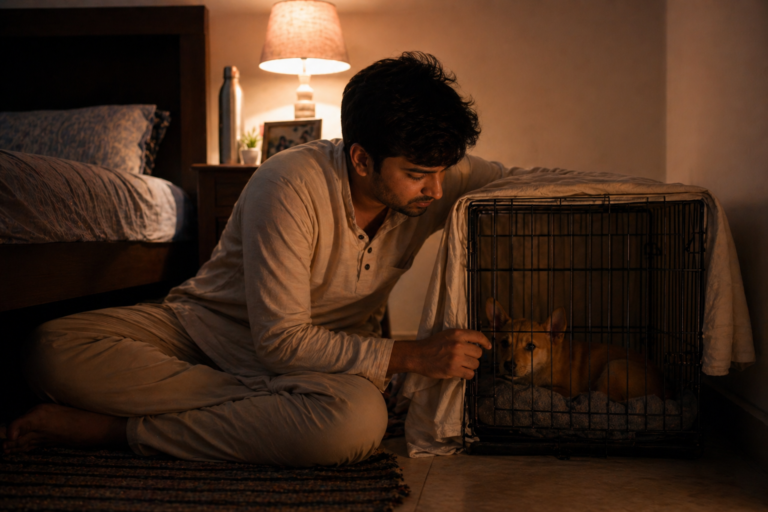
| Day 13 | Pre-overnight | Full pre-bedtime routine (from Night 1 blog). Crate in bedroom. Evening crate session 30–60 mins. Overnight attempt: first full night in the crate. | Overnight readiness achieved. Everything prepared for success. |
| Day 14 | Overnight + review | Review Night 1 based on the Night 1 blog protocol. Assess: daytime sessions solid? Overnight showing expected pattern? Adjust if needed. | Two weeks of consistent work. The crate is a home within a home. |
India-Specific Challenges During the 2-Week Plan
Indian pet parents face several specific obstacles during crate training that are rarely addressed in international content. Here are the most common ones — and exactly how to handle them:
| India-Specific Challenge | Why It Happens | The Solution |
| Family pressure to ‘let the puppy roam free’ | Family members often feel crating is cruel and put pressure on the primary carer to abandon it — especially elderly family members or those unfamiliar with modern dog training. | Brief, matter-of-fact explanation: ‘The crate is his safe space — like a bedroom. He goes in voluntarily and it makes him feel secure. The vet recommended it.’ Do not over-explain. Demonstrate the puppy going in voluntarily — that visual usually ends the debate. |
| Hot climate — crate comfort in summer | In Mumbai, Chennai, Hyderabad, and Bengaluru during summer months, a standard wire crate can become uncomfortably warm, making the puppy reluctant to enter. | Position the crate near a fan or AC vent (not directly under AC). Use a thin cotton pad, not foam. A wet cloth on top of the crate provides evaporative cooling. Avoid the crate near south-facing windows in the afternoon. |
| Small apartments — finding crate space | Many Indian apartments, particularly 1BHK and 2BHK configurations, make finding a quiet, permanent crate location challenging when space is limited. | The crate doesn’t need to be large — it just needs to be consistent. A corner of the bedroom with a cloth draped over it becomes a den regardless of size. Fold-flat wire crates that can be moved between rooms are ideal for Indian apartment living. |
| Domestic staff interacting with puppy during crate time | Cooks, cleaners, and domestic helpers may let the puppy out of the crate during sessions — particularly if the puppy cries — out of care or concern. | Brief conversation: ‘Please do not open the crate door if he is inside and crying — I know it seems hard, but opening it when he cries teaches him to cry more. I’ll take care of him during your visit.’ Most household staff respect this when given a clear reason. |
| Overnight noise — Indian apartment building sounds | Generator switches, lift noises, security guard rounds, early morning deliveries, and neighbours’ dogs can disturb crate-training progress in Indian apartment buildings. | A white noise app at low volume near the crate masks these intermittent sounds effectively. Many Indian pet parents use ‘rain sounds’ or ‘fan sounds’ on a phone placed near the crate — these are extremely effective for the first two weeks. |
| 📊 How to Know Your 2-Week Plan Is Working |
| End of Week 1 markers: puppy enters crate voluntarily when they hear the crate word, holds 15–30 minutes with a Kong, naps in crate without protest. |
| End of Week 2 markers: puppy goes in calmly at bedtime without major protest, holds overnight with 1–2 toilet trips, and exits the crate in the morning calmly rather than frantically. |
| If you have these markers at Day 14: the crate training foundation is solid. |
| If you have them partially: extend the current phase by 3–5 days before progressing. |
6. Step 5: The Overnight Routine — Once Daytime Sessions Are Comfortable
The overnight routine is not a separate process — it is the daytime crate training applied to the night-time context, with a specific pre-bedtime sequence that sets the puppy up for success.
Do not attempt overnight crate training until the puppy can comfortably hold 30 minutes in the crate during the day with you in another room. That daytime comfort is the prerequisite for overnight readiness. Rushing overnight before that foundation is established is the most common reason crate training feels like it ‘isn’t working.’
| Timing | Step | What to Do | Why It Matters |
| 90 min | Play session | 15–20 minutes of active floor play. Get the puppy genuinely physically tired — not agitated, tired. | Physical tiredness is the most reliable predictor of a good overnight. Skipping this step is the most common cause of restless first nights. |
| 70 min | Final meal | Last meal of the day. Remove water 60 minutes before sleep (available throughout the day). | Limits overnight bladder pressure. Do not restrict water during the day — only the final pre-sleep hour. |
| 45 min | Calm-down window | All high-energy activity ends. Dim lights. Calm voices. The puppy settles naturally in the living space before crate entry. | A wound-up puppy placed in a crate stays aroused and cries longer. The wind-down is not optional. |
| 20 min | First toilet trip | Outside or to the toilet spot. Wait 5–10 minutes. Allow full bladder emptying. Do not rush. | A fully empty bladder before bed extends the first sleep stretch significantly. |
| 15 min | Crate warm-up | Use the crate word. Toss 2–3 treats inside. Let the puppy go in voluntarily. Close door for 2 minutes. Open. Treat. 2 repetitions. | Prevents the crate from being associated only with the night. The daytime association is warm — carry it into the evening. |
| 5 min | Final toilet trip | One more toilet opportunity immediately before crate. Even if they went 20 minutes ago. | The single most effective way to extend the first sleep stretch. This step directly reduces the number of night wake-ups. |
| 0 min | Crate entry | Calm crate word. Treat inside. Puppy enters. Door closed. Brief calm ‘good night’. Lights low. No extended goodbye. Leave. | The energy of crate entry is the energy the puppy brings to the first hour. Matter-of-fact and calm = faster settling. |
| Night | Night response | If crying: decision tree (toilet or distress). Toilet: functional trip, straight back. Distress: presence at crate side, fingers through wire, calm voice. Never open for distress alone. | Refer to the Night 1 blog for the full decision tree. The same protocol applies every night. |
| Morning | Morning release | Open the crate only when the puppy is calm — not in the middle of a cry or bark. Wait for a 3-second pause in vocalisation, then open with the crate word and calm praise. | The morning release teaches: calm behaviour opens the door. Crying does not. This shapes a lifetime of crate behaviour. |
The Overnight Expectation Progression
The overnight timeline is realistic and predictable — as long as the daytime foundation was properly built:
- Night 1: 1–2 toilet trips. 20–45 minutes to settle initially. This is normal.
- Night 3–4: settling faster, often under 10 minutes. Sometimes only 1 toilet trip.
- Night 5–7: majority of puppies sleeping through large stretches (10pm–3am, then 3am–7am).
- Week 3–4: many 10-week-old puppies sleeping through the full night with one toilet trip.
- Month 3–4: most puppies sleeping 7–8 hours without waking when the crate routine is consistent.
The puppies who achieve this fastest are not the ones with the easiest temperaments — they are the ones whose crate training was done step by step, without shortcuts, with the 2-week plan fully executed before overnight was attempted.
When the Crate Becomes Voluntary
You will know crate training has fully succeeded when your dog begins going into the crate voluntarily during the day — without being asked, without food inside — simply to rest. This typically happens between 3 and 6 months of age for puppies who were crate trained from 8 weeks.
When you see this, resist the urge to close the door every time. Let them have it as an open space as much as possible. The crate that was once a training tool has become something far more valuable: a safe space the dog has claimed as their own. In an Indian apartment — without a garden, without outdoor access for decompression — this voluntary den is one of the most meaningful things positive crate training gives a dog.