Signs, Causes, and the Protocol That Works
By Harshad | Founder, Indieedogs | Puppy Training & Behaviour Specialist
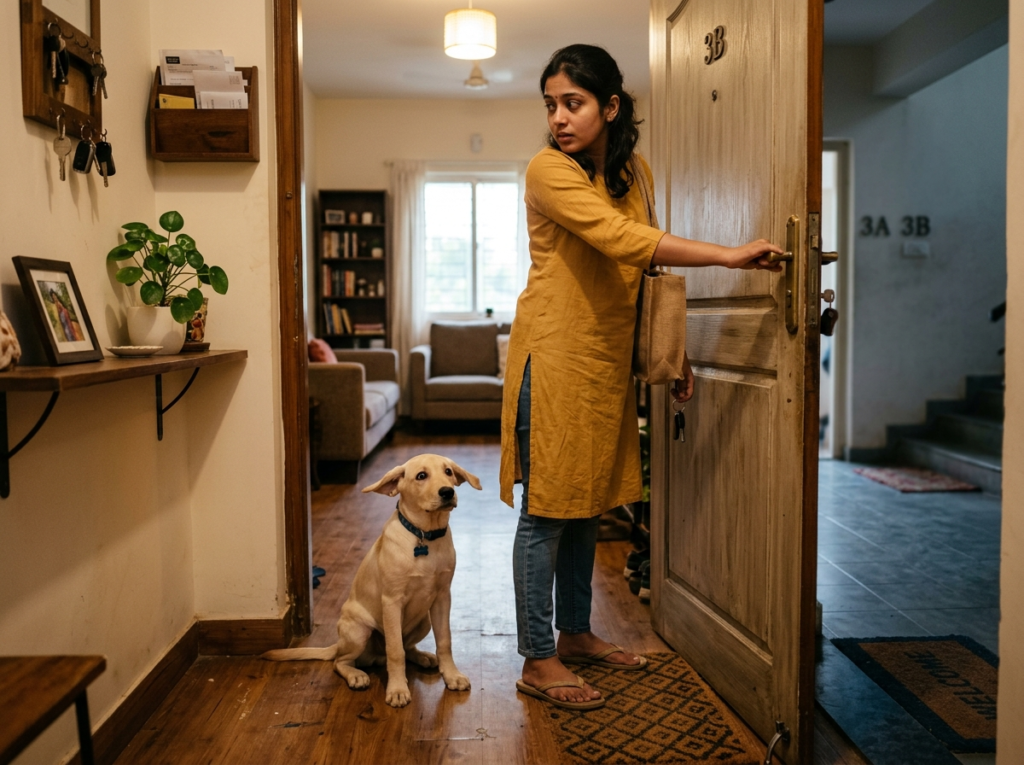
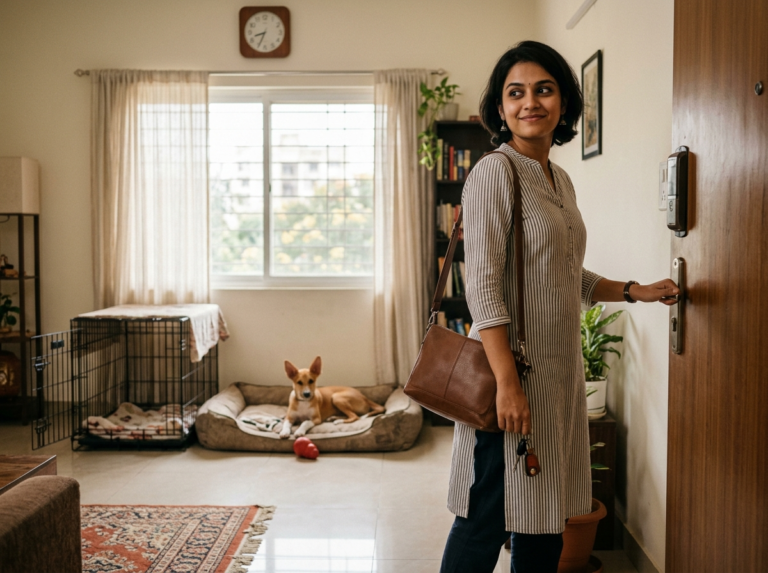
‘My dog cries every time I leave. Is that separation anxiety?’ It’s one of the most common questions I get from Indian pet parents. And the honest answer is: maybe. But probably not — at least not in the clinical sense.
The word ‘separation anxiety’ gets used for everything from a puppy protesting briefly when left alone to a dog in genuine physiological distress that causes vomiting, self-injury, and panic responses visible from outside the apartment. These two things require completely different responses. Getting the diagnosis wrong means applying the wrong protocol — and potentially making the real problem significantly worse.
This blog gives you everything you need: how to tell the difference, the three signs that confirm genuine anxiety, why the instinctive response (just let them cry) actively worsens true SA, and the gradual departure protocol that behaviour science supports. Plus the prevention programme that, if started at 8 weeks, means most puppies never develop true SA at all.
1. True Separation Anxiety vs Normal Puppy Protest — The Key Differences
The most important thing you can do before designing any intervention is accurately identify what you’re dealing with. True separation anxiety is a clinical anxiety disorder that requires a specific behavioural protocol. Normal puppy protest is a developmental behaviour that responds to gradual alone-time training.
They look similar on the surface — both involve a dog that is upset when left. The critical differences are in the intensity, duration, physical symptoms, and what triggers the distress:
| 😤 Normal Puppy Protest | 😰 True Separation Anxiety |
| Crying begins when left, settles within 10–15 minutes Dog is calm and can eat or play when alone Destructions are exploration-based, not panic-driven Settles in crate comfortably once trained Upset is proportional to the situation Behaviour is consistent — not escalating over time Responds quickly to gradual alone-time training No physical symptoms: no panting, drooling, or self-harm Will accept proximity of another familiar person or pet Triggered by: boredom, under-exercise, routine disruption | Panic begins within 30–90 seconds of departure — before you’ve even left the building Cannot settle regardless of duration alone Destructive behaviour is frantic and targeted at exit points (door, window frames) Crate confinement significantly worsens the response Distress is disproportionate — minor departure triggers full panic Behaviour typically escalates as the dog ages without treatment Requires structured desensitisation — does not improve with simple ‘leaving’ Physical symptoms present: panting, hypersalivation, self-injury, vomiting Triggered specifically by owner absence — not just any person leaving Pre-departure anxiety often present: distress begins before you even leave |
The Camera Test — Your Most Important Diagnostic Tool
The single most useful diagnostic step you can take: set up your phone on video in a position that captures your dog’s resting area. Step outside. Come back 20 minutes later and review the footage.
- If your dog settled within 10–15 minutes and rested for the remainder: you are dealing with normal protest. Gradual alone-time training resolves this within 1–2 weeks.
- If your dog was in continuous or escalating distress throughout the 20 minutes with no settled period: this is consistent with true SA. The gradual departure protocol in Section 4 applies.
- If your dog was in obvious distress but had brief settling moments: moderate anxiety — the protocol applies but progress will be faster than severe SA cases.
I recommend running this camera test before implementing any protocol. The footage tells you more than any questionnaire, and it removes the guesswork that leads to applying the wrong approach.
| 📹 The Camera Test Protocol |
| Use any smartphone camera — set to video recording. |
| Position it to capture the area where your dog typically rests or goes when you leave. |
| Leave the apartment and walk at least 3 floors away (or outside the building) for 20 minutes. |
| Return. Review the footage. Note: when did distress begin? Did it subside? Physical symptoms? |
| This footage tells you precisely which category your dog is in — and which section of this blog applies. |
2. The 3 Specific Signs That Confirm Genuine Anxiety
If the camera test suggests more than normal protest, these three signs confirm genuine anxiety and determine the severity of the protocol needed:
| Sign 1: Pre-Departure Anxiety — Distress Before You Leave |
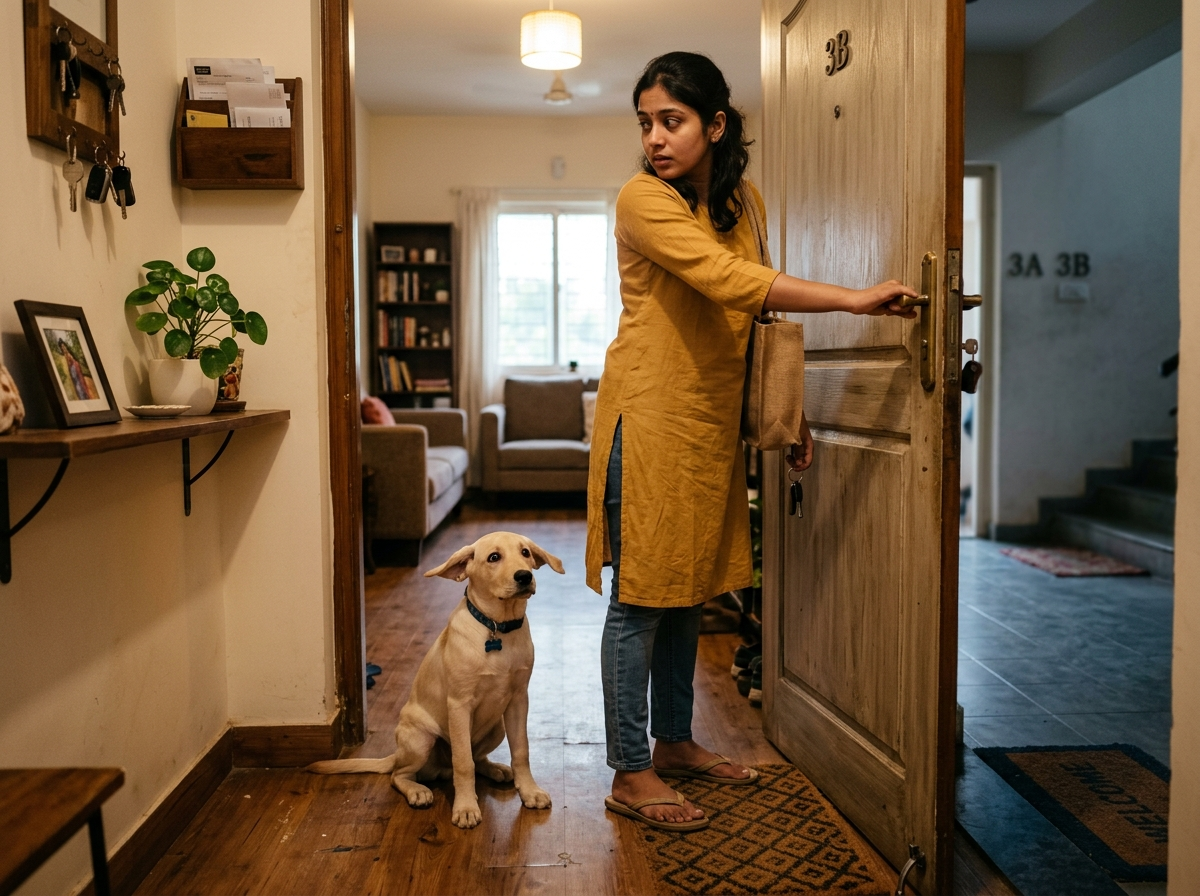
| What to watch for: Your dog becomes visibly distressed as soon as you begin departure rituals — picking up your keys, putting on shoes, picking up your bag, changing clothes. They start panting, following you frantically, pacing, or vocalising before you’ve opened the front door. |
| Why this confirms true SA: Normal separation protest begins at the departure — the door closing is the trigger. True separation anxiety begins at the anticipation of departure. The dog has learned that keys = you disappearing, and their nervous system begins flooding before the event even happens. |
| What to do about it: Pre-departure rituals need to be decoupled from actual departure. Pick up your keys and sit back down for 10 minutes. Put your shoes on and watch TV. Repeat until the ritual no longer triggers anxiety. This is the beginning of the protocol in Section 4. |
| Sign 2: The First 30 Minutes Are the Worst — and the Data Proves It |
| What to watch for: Set up a camera (most smartphones work) pointing at your dog while you step outside. Review the footage. Dogs with true SA show their most extreme behaviour in the first 30 minutes — typically within the first 5–10 minutes of departure. Panting, drooling, howling, pacing, scratching at the door. |
| Why this matters: Normal protest dogs settle within 10–15 minutes and then rest or explore. True SA dogs do not settle during this window. Their cortisol levels remain elevated for the entire absence and often for a period after return. |
| The camera test is the gold standard for home diagnosis. A dog who is quiet at 5 minutes does not have true SA. A dog who is still in full panic at 20 minutes almost certainly does. |
| Sign 3: Physical Symptoms That Go Beyond Vocalisation |
| What to watch for: Hypersalivation (excessive drooling on the floor or crate), vomiting or diarrhoea, self-directed behaviour (licking paws compulsively, spinning), loss of bladder or bowel control despite being toilet trained, weight loss if the pattern is long-standing, and in severe cases: self-injury through door scratching. |
| Why this confirms clinical anxiety: These are physiological stress responses, not behavioural choices. A dog who soils in the crate despite being reliably toilet trained is experiencing cortisol-driven loss of sphincter control. This is the body responding to perceived threat — not a naughty dog misbehaving. |
| Important: If you are seeing vomiting, self-injury, or persistent weight loss alongside separation behaviour — this warrants veterinary assessment in addition to behavioural protocol. In some cases, short-term anti-anxiety medication alongside the protocol produces significantly better outcomes than protocol alone. |
The SA Severity Assessment
After reviewing your camera footage and observing your dog against these three signs, you can place your dog in one of three categories:
- Mild SA: Pre-departure anxiety present but mild. Settles within 20–30 minutes. No physical symptoms. Camera test shows cycling of distress and brief settling.
- Moderate SA: Strong pre-departure anxiety. Does not settle within 30 minutes. May show drooling or loss of toilet control. Destruction targeted at exit points.
- Severe SA: Physical symptoms present (vomiting, self-injury). Continuous panic with no settling during any observed absence. Requires veterinary consultation alongside protocol.
For moderate and severe SA in dogs over 1 year old who have had the pattern for more than 3 months: professional trainer involvement accelerates outcomes significantly. This blog gives you the protocol foundation — a qualified trainer helps you execute it precisely for your specific dog.
| 🩺 When to See a Vet Alongside Training |
| Veterinary assessment is recommended when: |
| • Physical symptoms are present (vomiting, self-injury, significant weight loss) |
| • The dog has been in the severe SA pattern for more than 6 months |
| • The protocol has been followed consistently for 8 weeks with no measurable progress |
| Short-term anxiolytic medication from a vet, used alongside the behavioural protocol, |
| produces significantly better outcomes for severe SA than protocol alone. |
3. Why Crying It Out Makes True Separation Anxiety Significantly Worse
| The Cry-It-Out Problem The most intuitive response to a crying dog is also the most damaging one for true SA. Here is the science. |
‘Just leave them — they’ll get used to it.’ This is the most common advice given to Indian pet parents dealing with separation distress. And for normal protest dogs, it has some merit — they do settle, and consistency does help.
For dogs with true separation anxiety, this advice is actively harmful. Here is exactly why — and the mechanism behind each consequence:
| What Cry-It-Out Does | The Mechanism | Why It Matters for Your Protocol |
| Panic consolidation | Each cry-it-out session where the dog reaches full panic leaves a cortisol imprint on the stress response system. The threshold for triggering the next episode drops slightly each time. | Repeated unresolved panic exposures produce a sensitised stress response — meaning the anxiety response to separation triggers faster and more intensely with each episode. This is the opposite of habituation. |
| Learned helplessness | After multiple cry-it-out sessions without resolution, some dogs enter a state called learned helplessness — they stop actively trying to cope and become frozen or shut-down. | Shutdown behaviour can look like the dog has ‘accepted’ being alone. In reality the dog has given up trying to communicate distress. The underlying anxiety is unchanged or worse — it has simply stopped being visible. |
| Trust erosion | The panic state at departure becomes associated not just with being alone, but with the person who leaves. In some dogs, this produces hyperattachment behaviours between sessions that paradoxically worsen with cry-it-out. | Hyperattachment (following everywhere, unable to be in a different room, sleeping only on the owner) is a documented response to unresolved separation distress. The dog is trying to prevent the abandonment experience by never allowing physical separation to begin. |
| Amygdala sensitisation | The amygdala — the brain’s emotional alarm centre — habituates to non-threatening stimuli through calm, gradual exposure. Flooding it repeatedly with unresolved panic has the opposite effect. | Sub-threshold exposure = habituation. Over-threshold exposure = sensitisation. Cry-it-out for a true SA dog is over-threshold every single time. The protocol in Section 4 stays sub-threshold throughout. |
The distinction is critical: normal protest responds to consistency and graduated exposure because the dog is not in genuine panic. True SA does not respond to being left to habituate — because a panicking brain cannot habituate. It can only be sensitised further or calmed through sub-threshold graduated exposure.
The alternative is not ‘never leave them.’ It is the gradual departure protocol — which produces real, lasting change by keeping the dog sub-threshold throughout every session. The goal is never to cause the anxiety response. The goal is to expose the dog to departure cues just below the level that triggers panic, so that each cue loses its power gradually.
| ⚡ The Sub-Threshold Principle |
| The amygdala habituates to stimuli that are presented below the panic threshold. |
| It sensitises to stimuli that repeatedly trigger full panic. |
| Cry-it-out = over-threshold = sensitisation. |
| Gradual departure protocol = sub-threshold = habituation. |
| Every step of the protocol in Section 4 is designed to stay sub-threshold throughout. |
| If you see full panic at any step: the step was too large. Go back one stage. |
4. The Gradual Departure Protocol — Step by Step
This is the behaviour-science supported method for treating established separation anxiety. It is based on systematic desensitisation — the same approach used for phobias and anxiety disorders in both humans and animals. The protocol requires time, patience, and consistent execution. It produces reliable improvement in most cases when followed correctly.
Critical rule before starting: for the duration of the active protocol, your dog should not experience a full-panic absence. If you must leave for a genuine absence, arrange for someone to be with the dog — a family member, trusted neighbour, or dog sitter. A single full-panic session undoes multiple days of protocol progress.
| Phase | Duration | What to Do | Why This Stage |
| Phase 1 | 3–5 sec | Stand up from the sofa and sit back down. Repeat 10 times per session. The dog stays where they are without following. Reward calm non-following with a treat. | Teaching that human movement is not a departure signal. For severe SA dogs, even standing up triggers anxiety. Start here. |
| Phase 2 | 10–15 sec | Walk to a different room and come back within 15 seconds. No goodbye ritual. No eye contact on departure. Return and be calm — no big greeting. | The first actual physical separation. Keep the return casual — big reunions reinforce that the departure was significant. Matter-of-fact = message is: this is normal. |
| Phase 3 | 30 sec | Walk to the front door, touch the handle, come back. Then: open the door, step outside for 3 seconds, come back. Increase to 15 then 30 seconds outside. | Door desensitisation. The front door is the highest-anxiety trigger for SA dogs. Touch it, open it, step through it — all without the full departure response activating. |
| Phase 4 | 2–3 min | Leave the apartment. Wait in the corridor or stairwell for 2 minutes. Return before any distress reaches full panic. Use the camera to monitor. | The first real departure. The camera is essential — you need to know whether the dog is sub-threshold or not. If they are in full panic within 30 seconds, go back to Phase 3. |
| Phase 5 | 5–10 min | Extend corridor/building time to 5–10 minutes. Multiple sessions per day. Vary the departure — sometimes 2 minutes, sometimes 7 minutes. Unpredictability reduces anticipatory anxiety. | The graduated exposure is working. Varied duration is important — if departure always means 3 hours, the dog learns to panic proportionally. Short random departures retrain the association. |
| Phase 6 | 20–30 min | Short local trip: to the building entrance and back, to a nearby shop, a 20-minute walk. Real departure but still short. Camera confirms sub-threshold response throughout. | At this stage the dog is learning: departure happens AND return happens. The absence is finite. This is the core cognitive shift required for SA resolution. |
| Phase 7 | 1–2 hours | Standard work-from-home departure lengths. If the dog is sub-threshold at 30 minutes, 1–2 hours is generally achievable within the same week. | The functional milestone. This is what most pet parents working from home need as a daily minimum. Reach this before attempting full workday departures. |
| Phase 8 | 3–8 hours | Full workday departures. Only attempted once Phase 7 has been consistent for at least 5 days. A dog walker or mid-day check-in significantly reduces the ask at this stage. | For Indian working pet parents: a dog walker, trusted neighbour check-in, or doggy daycare at the 4-hour mark is not failure — it is smart management during the consolidation phase. |
The Departure Ritual Decoupling Exercise
Alongside the departure protocol, systematically decouple your pre-departure rituals from actual departure. This addresses the pre-departure anxiety that many SA dogs show (Sign 1 from Section 2).
- Pick up your keys and sit back down on the sofa. Do this 20 times per day for 5 days.
- Put your shoes on and stay home for 30 minutes. Eat breakfast with your shoes on. Remove them later.
- Pick up your bag and put it by the door, then work at your desk for an hour.
- Put on your work clothes and stay home all day.
These exercises feel pointless. They are not. Each repetition of a departure cue that does not result in departure reduces the cue’s predictive power. After 5–7 days of consistent decoupling, most dogs show measurably reduced pre-departure anxiety. This makes the actual departure protocol significantly more effective.
India-Specific Context: The SA Factors Unique to Indian Pet Parents
| India-Specific Factor | Why It Creates SA Risk | What to Do About It |
| Work-from-home culture | Indian urban professionals working from home (a trend accelerated post-2020) are with their dogs almost constantly — creating the conditions for hyperattachment without realising it. | Even while working from home: schedule one 20–30 minute alone-time session daily. Close the home office door. Leave the apartment briefly. The dog must experience your physical absence regularly regardless of your work setup. |
| Joint family households | In multigenerational households, someone is almost always home — the cook, a family member, a grandparent. The dog may never actually be alone, which delays the development of alone-time tolerance. | Someone being home is not the same as the attachment figure being home. If the dog is attached primarily to one person, their absence is still a trigger regardless of other people being present. Solo absence practice is still essential. |
| COVID-era dogs | Puppies adopted during the pandemic lockdowns grew up with their owners constantly present. Many of these dogs are now 3–4 years old with established SA — triggered when the owners returned to office. | This is the single largest cohort of Indian dogs with genuine SA. If your dog was a pandemic puppy and is now struggling with your return to office: the protocol in Section 4 applies, with realistic timelines from Section 6. |
| Domestic staff presence | Having a cook or cleaner present does not prevent SA in dogs who are primary-attachment to the owner. The presence of domestic staff can mask the SA from owners who assume ‘someone is home so they’re fine.’ | Use the camera during a genuine alone window — not when domestic staff are present. The true alone-time response is what you need to see and address. |
| No-dog-left-alone culture | Many Indian families believe it is unkind to ever leave a dog alone and arrange constant coverage through family members, staff, or neighbours — preventing the development of any alone-time tolerance. | Constant coverage during the puppy phase, while feeling kind, produces a dog that cannot tolerate any absence later in life. Short, regular, positive alone-time starting from 8 weeks is one of the most important welfare acts for an Indian urban dog. |
| 🐾 The One Non-Negotiable for Indian Working Pet Parents |
| If you work outside the home for 8+ hours: a dog with true SA cannot be left alone for that duration during the treatment phase. |
| You need a bridge: a trusted dog walker at the 3-hour mark, a family member who can check in, or doggy daycare during the training period. |
| This is not a permanent arrangement — it is the management strategy that allows the protocol to progress without full-panic setbacks. |
| Once the protocol reaches Phase 7 (1–2 hours consistently), full workday tolerance typically follows within 2–4 weeks. |
5. How to Build Alone-Time Tolerance From 8 Weeks — Before Anxiety Develops
| Prevention Is 10x More Effective Than Treatment The 8-week alone-time programme. Run this from the day the puppy comes home. |
Everything in Sections 1–4 addresses a problem that has already developed. This section is for pet parents who still have the chance to prevent it.
The research on separation anxiety prevention is unambiguous: puppies who are exposed to regular, positive, brief alone-time starting from 8 weeks develop significantly better alone-time tolerance than those who are not. The window for prevention is the same window as socialisation — and it’s just as easy to miss.
I have worked with many Indian pet parents whose dogs developed SA not because they were unkind or inattentive owners — but because they were so loving that they were always present. The puppy never had a reason to learn that alone-time was finite, normal, and safe. Here is the programme that prevents that outcome:
| Week | Focus | What to Do | Why This Matters |
| Wk 8 | Room separation | Leave the puppy alone in a room (puppy-proofed, safe) for 2–3 minutes while you are elsewhere in the apartment. Return calmly. No drama. Repeat 3 times daily. | Introducing alone-time as a completely normal, unremarkable event from the first week. The earlier this starts, the more neutral it registers. |
| Wk 9 | Crate alone-time | Crate sessions of 15–20 minutes with a Kong while you are in another room. Not watching, not hovering. Doing other things. Return when the session ends — not when the puppy makes noise. | Crate + alone-time + Kong = a three-part package that directly prevents SA. Do not skip this week. |
| Wk 10 | Short departures | Leave the apartment for 5–10 minutes daily. Use the camera. Return before any distress reaches full panic. Build to 20–30 minutes across the week. | First real departures during the prevention window. These must happen during Week 10 — waiting until Month 3 to begin departures is one of the most common causes of developed SA. |
| Wk 11 | 30-min routine | A 30-minute alone time becomes a daily fixture. Same time daily — after morning walk is ideal. The puppy learns this time pattern is reliable and finite. | Predictable alone-time trains the dog that departure is routine — not an emergency. The regularity matters as much as the duration. |
| Wk 12 | Independence cues | Actively reinforce settling behaviours: going to their bed voluntarily, lying separately from you, self-directed play. Reward these generously. Reduce following by not always responding to proximity-seeking. | Independence is a skill that can be taught as deliberately as any other command. Many SA-prone dogs have been inadvertently trained into dependence by owners who always responded to proximity-seeking. |
| Wk 13–14 | 1–2 hour sessions | Alone time extends to 1–2 hours multiple times per week. Introduce variability — sometimes 45 minutes, sometimes 90 minutes. Dog walker or second caregiver begins to visit regularly. | Variable duration prevents the dog from clock-watching. A dog who has experienced 3 minutes, 20 minutes, and 90 minutes learns: departure does not have a predictable length. |
| Wk 15–16 | Full-day readiness | The puppy should be able to tolerate a 4-hour alone window. A mid-day check (dog walker, neighbour, family member) bridges to a full workday if needed. | The end of the prevention window. A puppy who has been through this 8-week programme is significantly less likely to develop true SA regardless of breed disposition. |
| Ongoing | The daily habit | One alone-time session per day for life — even weekends, even when working from home. 20–30 minutes of deliberately alone time, daily, is the maintenance dose of the prevention programme. | The most common relapse trigger: a period of constant togetherness (lockdown, extended leave, working from home full-time) that resets the dog’s baseline for ‘normal.’ Maintain the daily habit regardless. |
The Breeds That Need This Most
While any dog can develop SA, certain breeds have higher predisposition and need this programme executed most carefully:
- Labrador Retrievers — bred for constant human partnership. Very high SA risk without prevention.
- Golden Retrievers — similar to Labradors. Highly people-oriented. Prevention is critical.
- Beagles — pack dogs by nature. Alone-time is deeply unnatural for them. Prevention programme is essential.
- Cavalier King Charles Spaniels (increasingly common in Indian metros) — bred specifically for human companionship. Extremely high SA predisposition.
- Indie dogs adopted from street situations — some adapt quickly to home life, but the sudden shift from constant social exposure to apartment alone-time can trigger SA in sensitive individuals.
For these breeds especially: starting the prevention programme in Week 8 is not optional. It is the welfare minimum for responsible ownership.
| 💡 The Most Common Prevention Mistake |
| Taking three months of parental leave or extended leave to be with the puppy full-time — then returning to work. |
| The puppy spends months with constant human contact, develops a baseline expectation of that presence, |
| and then experiences the owner’s return to work as a sudden, dramatic change. |
| If you take extended time at home with a puppy: run the prevention programme simultaneously. |
| Include deliberate alone-time daily regardless of how much time you have. |
| The goal is not to be away — it is to ensure the puppy has a reliable positive relationship with being alone. |
6. Realistic Timeline — How Long Does It Actually Take?
This is the question every pet parent wants answered — and the honest answer is: it depends on when the SA developed, how severe it is, and how consistently the protocol is followed. Here is the realistic picture by category:
| Situation | Realistic Timeline | What to Expect |
| Mild protest (normal) | 1–2 weeks | With consistent gradual departure training and daily alone-time, mild protest resolves to calm tolerance in 1–2 weeks for most puppies under 6 months. |
| Moderate SA (under 6 months) | 3–6 weeks | Puppy was not given adequate alone-time during the socialisation window. With the gradual departure protocol started now, 3–6 weeks of consistent work produces significant improvement. |
| Established SA (6 months–1 year) | 6–12 weeks | Protocol needs to be followed more carefully at each stage. Progress is measurable weekly. Most dogs in this category reach functional alone-time (2–4 hours) within 8–12 weeks of consistent protocol. |
| Established SA with physical symptoms | 8–16 weeks + vet | Veterinary assessment recommended alongside protocol. Short-term anti-anxiety medication (from your vet) combined with behavioural protocol produces significantly better outcomes than protocol alone in this category. |
| Long-standing SA (1+ years) | 3–6+ months | The longest and most demanding category. Progress is slower and requires professional trainer involvement. Significant improvement is still possible — but expectations need to be calibrated realistically. The goal is functional tolerance, not perfection. |
| Prevention (puppy from 8 weeks) | 8 weeks | Prevention is incomparably more effective than treatment. A puppy who has experienced the 8-week prevention programme almost never develops true SA regardless of breed predisposition. Prevention is where the real ROI is. |
The Progress Markers to Watch For
Across all categories, these are the signs that the protocol is working. Note them as they appear — they are your evidence that the work is moving the needle:
- The pre-departure anxiety reduces — picking up keys no longer triggers visible distress
- The settling time after departure shortens — from 30 minutes to 15 minutes to 5 minutes
- The first full departure where the camera shows the dog at rest within 10 minutes
- The dog begins seeking the crate or bed voluntarily when they see departure cues
- A full workday absence with no destructive behaviour, no soiling, and camera footage showing rest
These milestones don’t all happen at once. They appear one by one across the weeks of consistent protocol work. Each one is a measurable shift in the dog’s nervous system — a piece of evidence that the amygdala is habituating and the stress response threshold is rising.
When to Consider This Resolved
Separation anxiety is functionally resolved when your dog can be left alone for the duration required by your lifestyle — without physical symptoms, without destructive behaviour, and with camera footage showing the dog settling within 10 minutes and resting for the bulk of the absence.
Perfect is not the goal. Functional is the goal. A dog that takes 5–10 minutes to settle before resting is not anxious — they are being a dog. The physiological crisis state — the panting, the drooling, the continuous panic — that is what the protocol resolves. What remains afterward is normal canine settling behaviour.
For most dogs who receive the gradual departure protocol consistently and correctly: this functional resolution is achievable. It takes work, patience, and in some cases professional support. But it is real, and it is worth it.