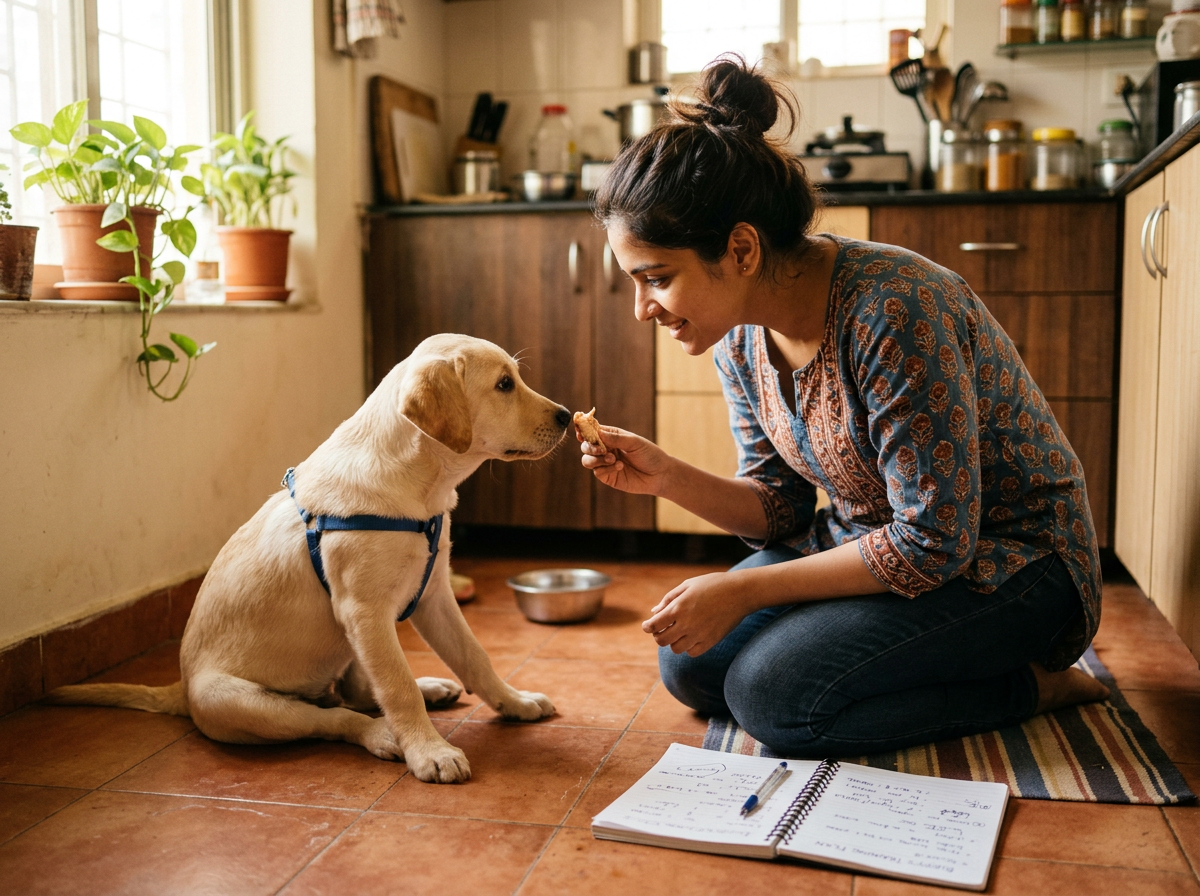
How to Get Back on Track — Your Concrete 4-Week Plan
By Harshad | Founder, Indieedogs | Puppy Training & Behaviour Specialist
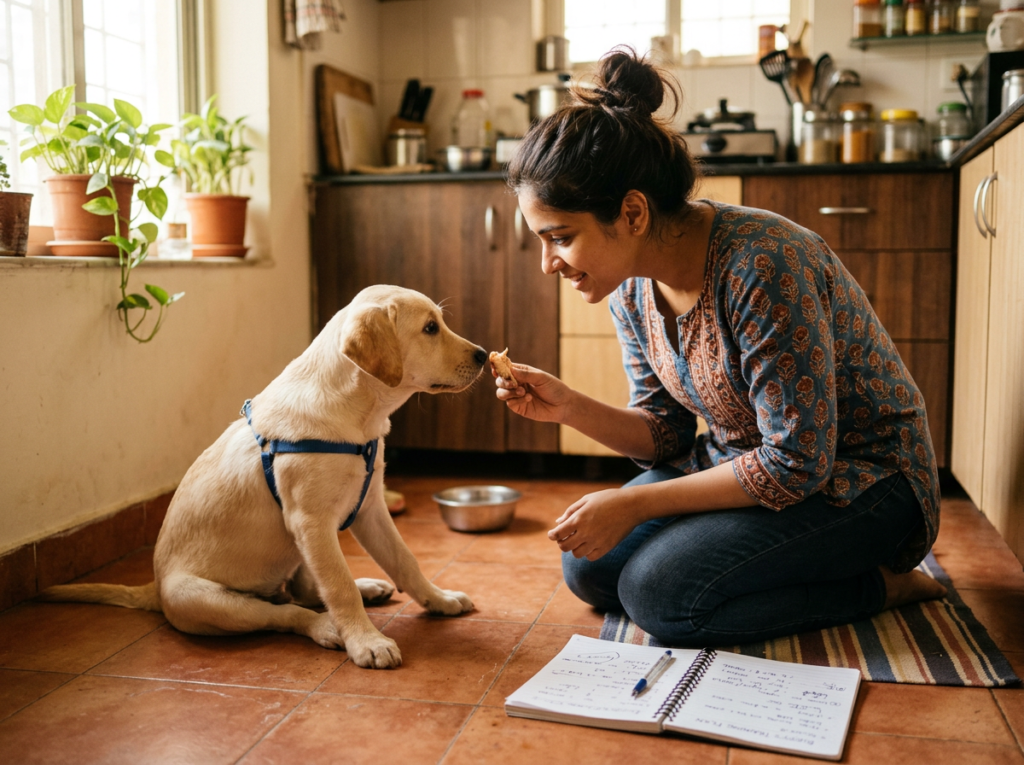
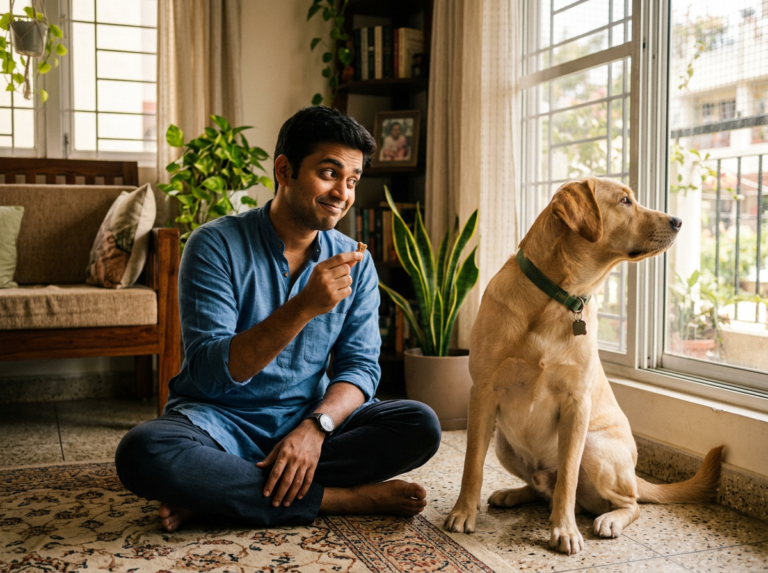
Six months. Your puppy was doing so well. And then — seemingly overnight — the sit stopped working, the ‘come’ became optional, and the leash manners you spent weeks building collapsed in a heap. You’re standing in your building compound at 7am, holding a treat your dog has decided is beneath them, wondering what on earth happened.
Here’s what happened: adolescence. And more specifically, the 6-month regression — the first major wave of adolescent brain remodelling that turns a cooperative, trainable puppy into what feels like a completely different dog.
The good news is that this regression is completely predictable, well understood, and fully reversible. The dogs that come out of this phase with the strongest training are not the ones with the best genes or the most talented owners — they’re the ones whose owners understood what was happening, adjusted their approach, and stayed consistent through the dip.
This blog is your practical guide to doing exactly that. By the end, you’ll have a clear 4-week recovery plan that starts this week — not someday when things feel better.
1. What Regression Is and Exactly Why It Happens at 6 Months
Regression at 6 months is not your dog forgetting their training. It’s your dog’s brain temporarily changing the environment in which that training was stored and accessed. Understanding that distinction is everything.
Here’s what’s actually happening:
| The Cause | What’s Happening | What It Means for Your Training |
| Prefrontal cortex remodelling | The brain’s impulse-control centre temporarily loses efficiency. Your dog literally cannot self-regulate as well as they could at 12 weeks. | Learned behaviours haven’t vanished — the circuit to access them under arousal is temporarily unreliable. This is why the kitchen sit is fine but the compound sit is gone. |
| Dopamine surge — environment wins | Novel stimuli release more dopamine than your treats do. The scooter, the stray cat, the smell from the food stall — all more neurologically compelling than ‘sit’. | You haven’t lost authority. You’ve been outbid by biology. The fix is higher-value rewards and training in distraction — gradually building back your value against the competition. |
| Testosterone / oestrogen peak | Sex hormones flood the system between 6 and 10 months. In males this activates roaming instinct, marking, and inter-dog tension. In females, the pre-heat period is also disruptive. | Hormonal regression peaks around 8–10 months and gradually resolves. Neuter timing discussions with your vet are relevant here — see the adolescence blog for detail. |
| Second fear imprint period | A neurological fear-sensitive window activates around 6–9 months. Things that seemed ‘normal’ — the lift, the security guard, the sound of the mixer — may suddenly trigger alarm responses. | Don’t force through sudden fears. Brief, positive re-exposure (same socialisation techniques as puppyhood) resolves most second fear period responses within 2–4 weeks. |
| Physical growth disruption | Between 5 and 8 months, most dogs experience rapid physical growth that affects proprioception — their sense of body position. They may seem clumsy or uncertain on new surfaces. | Sudden reluctance on stairs, hesitation at doorways, and generalised awkwardness is physical, not behavioural. It resolves as growth plates stabilise. |
The most important thing to take from this table: every cause of regression at 6 months is temporary. The prefrontal cortex remodelling completes. The hormones stabilise. The fear period resolves. Physical growth stabilises. None of these are permanent states. The regression has a biological end date.
What makes the 6-month regression feel particularly sharp is timing: it often hits just as the puppy phase was starting to feel manageable. You’d done the hard work. Things were working. And then the rug gets pulled. That contrast — progress followed by regression — makes it feel more dramatic than the biology actually warrants.
| 🔑 The Regression Reality Check |
| Your training is not gone. The knowledge is stored. |
| What’s temporarily impaired is the brain’s ability to access that knowledge under arousal. |
| This is like having information in a filing cabinet during an earthquake — |
| the information is still there, the filing system is just temporarily unreliable. |
| When the neurology settles: the files are intact and the system works again. |
2. The 3 Most Common Regression Patterns — What Causes Each One
Regression doesn’t look the same for every dog. Understanding which pattern your dog is experiencing determines the right recovery approach. Here are the three most common patterns, their causes, and their fixes:
| Pattern 1: The Distraction Collapse | |
| What it looks like | Root cause |
| • Works perfectly indoors — vanishes outdoors • Responds to name at home, blank stare on walks • Sit and stay intact in familiar room, gone near any distraction • Seems to ‘switch off’ the moment the environment gets interesting | This is the dopamine competition problem. The environment is simply more rewarding than your cue. The behaviour hasn’t been forgotten — it hasn’t been trained in that context yet. You built the behaviour indoors. You now need to rebuild it outdoors, at a low distraction level, and work up. This is the most common regression and the most straightforward to fix: proof in distraction, starting small. |
| Pattern 2: The Selective Amnesia | |
| What it looks like | Root cause |
| • Some commands still work, others vanish completely • Sit intact — come completely gone • Stay reliable — name response unreliable • Responds to high-energy cues, ignores calm ones | Commands that required more impulse control collapse first — recall especially demands the dog override their own momentum, which requires the very prefrontal function that’s degraded. Commands paired with high-energy responses (sit for meal, sit for lead) survive because motivation is built in. This is not selective stubbornness — it’s selective neurological capacity. Fix: Prioritise the fallen commands above all others. Rebuild recall and name response with multiple short daily repetitions. |
| Pattern 3: The Full Reboot | |
| What it looks like | Root cause |
| • Everything has degraded simultaneously • Toilet training unreliable again • No command works reliably anywhere • Dog seems uninterested in training entirely — won’t engage • Walks are chaotic, pulling returned, reactivity increased | Usually triggered by hormonal peak combined with under-exercise and insufficient mental stimulation. The full reboot pattern means the dog’s arousal baseline is too high for any learning to penetrate. Fix starts with exercise and enrichment, not training: 45+ minutes of physical exercise daily, plus nose work or food puzzles. Arousal must come down before training can land. This pattern takes the longest to fix — typically 4–6 weeks — but it fully resolves with the right approach. |
Which Pattern Is Your Dog In?
Ask yourself three questions:
- Does my dog still respond in easy, familiar, low-distraction environments? → If yes: Pattern 1 (Distraction Collapse).
- Do some commands still work reliably while others are completely gone? → If yes: Pattern 2 (Selective Amnesia). Focus on the fallen ones specifically.
- Has everything collapsed simultaneously, including toilet training, and does my dog seem uninterested in training at all? → Pattern 3 (Full Reboot). Start with exercise and enrichment before you touch training.
Most dogs show a mix of Pattern 1 and Pattern 2. Pure Pattern 3 is the most challenging — but also the one where exercise and enrichment produce the most dramatic turnaround, often within 5–7 days.
| ⚡ The Pattern 3 Emergency Protocol |
| If your dog is in Pattern 3 (full reboot) — stop training sessions for 5 days. |
| Replace all that time with: 45+ minutes of physical exercise per day AND one daily enrichment activity. |
| Then reassess. In most cases, the engagement returns once the arousal baseline drops. |
| You cannot train an adolescent dog whose system is flooded. You have to drain the flood first. |
3. How to Re-Engage a Distracted Adolescent Puppy Who Has Lost Interest in Training
| The Re-Engagement Toolkit The problem isn’t your training. It’s your competition. Here’s how to win it back. |
The most common mistake at this stage is working harder with the same approach — more repetitions, more commands, more frustration. What actually works is changing the variables: the reward, the environment, the session structure, and the energy you bring.
| Technique | What to Do | Why It Works for Adolescent Dogs |
| Change your reward entirely | Switch from kibble to real food — boiled chicken, paneer, cheese. Test which food produces the most excitement and use that for training. | Adolescent dopamine surge means low-value rewards simply can’t compete. Real food changes the economics of training. Reserve the highest-value treat exclusively for training — not casual feeding. |
| Introduce the ‘consent to train’ check | Before every session, offer your dog a small piece of the training treat. If they eat it eagerly — proceed. If they turn their nose up — end the session and try again when they’re hungrier or calmer. | Forcing training on a non-engaged dog teaches them that training is something that happens to them. Consent checks build a dog that actively wants to engage. It takes 30 seconds and changes the training relationship. |
| Use movement and play as rewards | For dogs that have lost food interest, use 2-second tug, a chase game, or a ‘free’ sprint as the reward for a command. Movement releases dopamine directly. | This is especially powerful for Indie dogs and high-drive breeds during adolescence when food motivation has temporarily dimmed. The play reward bypasses the dopamine competition problem. |
| Train in new environments | Instead of the usual room or compound spot, try a new corner of the building, a different floor, outside a shop you rarely visit. | Novelty increases alertness and curiosity — which briefly increases attention. Training in a new place also resets the ‘this is boring’ association the dog may have formed with the usual training spot. |
| Shorten everything dramatically | Cut session length to 2–3 minutes. End before your dog disengages. Leave them wanting more. | Adolescent attention spans are genuinely shorter. The moment your dog mentally checks out, every subsequent repetition is wasted or harmful. Short sessions that end on success > long sessions that end on failure every single time. |
| Make the first 3 repetitions wins | Start every session with the 3 easiest things your dog still does reliably — even if that’s just ‘look at me’ or ‘touch my hand.’ Build momentum before asking for harder things. | A dog that experiences early success in a session is more engaged for the rest of it. Starting with something they’ll fail at creates a negative loop. Start with wins, then raise the bar. |
The ‘Find It’ Reset — A 60-Second Engagement Starter
If your dog walks into a training session flat and uninterested — try this before anything else. Toss a tiny piece of high-value treat on the floor and say ‘find it!’ in an upbeat voice. Let them sniff it out. Repeat 5 times. The act of sniffing and finding activates the seeking circuit in the brain — the same circuit that makes training rewarding. You’ve just primed the pump.
Most dogs that enter a session disengaged become visibly more present after 60 seconds of this. Then begin your actual session immediately while that engagement is live.
| 🎯 The Re-Engagement Rule |
| Your dog’s engagement is not a given — it’s something you earn at the start of every session. |
| Consent check → Find It reset → 3 easy wins → then ask for the real work. |
| This 90-second warm-up sequence changes the quality of the entire session. |
| A dog that chose to engage trains better than a dog that was obligated to. |
4. Whether to Go Back to Absolute Basics or Push Forward
This is one of the most common questions I get during the regression period — and the answer depends entirely on where your dog’s reliability actually sits right now, not where it was two months ago.
| ⬅️ Go Back to Basics When… | ➡️ Keep Pushing Forward When… |
| The command has less than 60% reliability in easy environments Your dog isn’t engaging with training sessions at all Multiple behaviours have collapsed simultaneously Your dog is showing signs of stress or shutdown in sessions You’ve had no positive sessions in more than a week The regression is paired with a fear response (second fear period) Going back to basics means: simplest version, highest reward, easiest context. It is not failure. It is precision. | The behaviour is at 70%+ reliability in easy environments but degrades in distraction Your dog is engaging, keen, and food-motivated — just inconsistent Only 1–2 specific behaviours have regressed Regression appeared in the last 1–2 weeks only (new phase onset) Your dog responds well to easier cues in the same session Pushing forward means: same behaviour, harder context, graduated distraction. You are proofing, not rebuilding. Most 6-month regression falls into ‘back to basics’ territory. Most 10-month plateau falls into ‘proof in distraction.’ |
The Reliability Test
Before deciding, run a simple reliability test. In your home with no distractions, ask for each core behaviour 10 times. Count the successes.
- 8–10 out of 10: Behaviour is intact at home → proof in distraction, don’t rebuild from scratch
- 5–7 out of 10: Behaviour is shaky → go back one step (shorter duration, closer distance, same environment)
- Below 5 out of 10: Behaviour needs rebuilding → start from the simplest version regardless of what was working before
Run this test for: sit, down, stay (5 seconds), recall (10 steps), and name response. The results tell you exactly where each behaviour sits — and you’ll often find some are intact while others need rebuilding. Treat each one individually.
| 📏 The 80% Rule |
| A behaviour is only ‘trained’ when it works 80% of the time in the current environment. |
| If it’s below 80% — even if it worked perfectly last month — treat it as untrained for now. |
| This is not a setback. It’s an accurate assessment. |
| Accurate assessment → correct intervention → fastest recovery. |
5. Why Short High-Value Training Sessions Work Better During Adolescence
| The Session Length Science The adolescent brain is not a smaller adult brain. It’s a differently configured one. Train accordingly. |
Most pet parents who struggle with adolescent training have one thing in common: they’re still running the same session length they used during the puppy phase — or even longer, reasoning that more practice must mean more progress.
The science says the opposite. Here’s why session length needs to change:
| Stage | Optimal Length | Content | Why This Length |
| Adult dog (18+ months) | 15–20 mins | Full command repertoire in moderate distraction | Standard positive reinforcement sessions. Can include duration, distance, and distraction work in one session. |
| Puppy 8–16 weeks | 5–10 mins | Single new behaviour + 2 known behaviours | Short because attention span is genuinely short, not because of arousal. Multiple sessions per day are ideal. |
| Adolescent 6–12 months | 3–6 mins MAX | 1 behaviour focus. Start with 2 easy wins. | Adolescent brain fatigues and loses engagement faster due to dopamine surge and PFC remodelling. Session must end before engagement drops. Quality over quantity absolutely. |
| Adolescent in regression | 2–4 mins | Known behaviours only. No new learning. | In regression, the session purpose is to maintain the association between training and positive outcomes — not to teach. Ending on success restores motivation for the next session. |
What High-Value Actually Means
In India, ‘high-value treats’ is often interpreted as the premium training treats sold at pet stores. But for most dogs — especially adolescent ones — real food beats commercial treats every time.
The hierarchy of treat value for most Indian breeds during adolescence, from highest to lowest:
- Boiled chicken (small pieces, pea-sized) — the gold standard for most Indian dogs
- Fresh paneer — particularly effective for dogs that have become food-bored
- Cheddar or processed cheese — high fat, high palatability
- Liver (boiled or baked) — extremely high value for scent-driven breeds like Beagles and Indie dogs
- Commercial training treats (Drools, Pedigree training rewards) — medium value, good for maintenance
- Kibble — low value during adolescence, mostly useful for non-distraction home work only
Keep your highest-value treat — whatever that is for your specific dog — exclusively for training sessions. Don’t use it for casual rewards or handouts. Its scarcity is part of its value.
The 3-Session-Per-Day Formula
Three sessions of 3–5 minutes each, spread across the day, consistently outperform one 15-minute session. The reasons are straightforward: the dog comes to each session fresh and hungry, each session ends before engagement drops, and the training signal fires three times per day rather than once. Over a month, this is literally triple the quality training repetitions.
For busy Indian working pet parents: these sessions don’t need a dedicated time and space. Session 1 at breakfast while the food is being prepared. Session 2 when you get home from work. Session 3 after dinner. Each one is 3 minutes. It costs 9 minutes of your day and produces extraordinary results over a 4-week recovery period.
| ⏱️ The Golden Rule of Adolescent Training |
| End every session before your dog disengages. |
| The moment you see the ears drop, the attention drift, or the feet shuffle — stop. |
| End with a jackpot treat and genuine praise. |
| A session that ends when the dog is still engaged teaches: training ends well, I want more. |
| A session that ends in disengagement teaches: training eventually becomes something I want to escape. |
6. Your Concrete 4-Week Recovery Plan — Starting This Week
No theory. No vague advice. Here is the exact plan, week by week, with daily actions:
| Week | Theme | Daily Actions | Goal |
| Wk 1 | Foundation Reset | Stop all advanced work entirely. Exercise for 45 mins daily — morning walk + evening play session. Introduce 1 food puzzle or sniff game per day. Run 3 x 3-min sessions per day using only the 3 easiest behaviours your dog still does: sit, look at me, touch hand. Use your highest-value treat. End every session on a win. | Lower the arousal baseline. Rebuild a positive association with training sessions. Establish the consent-to-train check. |
| Wk 2 | Core Behaviour Rebuild | Maintain exercise and enrichment from Week 1. Add 1 previously collapsed behaviour — recall is the priority. Use the garden call game: 10 rapid short-distance recalls per session with the best treat possible. Do not use recall on walks yet. Extend sessions to 4–5 mins if engagement is strong. Introduce training in one new location (different room, balcony, compound corner). | Restore recall and name response in easy environments. Build momentum by introducing controlled novelty. |
| Wk 3 | Distraction Introduction | Add low-level distraction to known behaviours. Practice sit at the front door (mild excitement). Practice recall with one family member present. Begin leash training re-work using stop-and-wait method in the building compound only. Extend sessions to 5–6 mins if engagement strong. Maintain enrichment daily. | Prove behaviours against low-level real-world distraction. Begin testing whether the foundation is back. |
| Wk 4 | Progressive Proofing | Take the best 3 behaviours from Week 3 and practice them in moderately busier environments: compound gate at active time, near the lift at peak hour, on a quiet lane at 7am. Begin re-introducing 1 advanced behaviour if Week 3 went well. Keep sessions at 5–7 mins. Celebrate specific wins loudly — with your voice and a jackpot treat. | Confirm the recovery is real. Assess what still needs work for Month 2. Build confidence for both of you. |
The Daily Schedule That Makes It Work
The plan above gives you the weekly structure. Here’s what a single day inside that plan looks like — practical, realistic, built for Indian apartment life:
| Time | Activity | Why This Slot |
| 6:30–7:00am | Morning walk — 20–30 mins (exercise, not training). Let them sniff freely. This is their decompression time. | No commands during free-sniff time. Allow the arousal from waking to settle through movement. |
| 8:00am | Breakfast — feed from a lollipop food puzzle or scatter feed in the garden. 10 mins of problem-solving. | Mental fatigue from enrichment reduces afternoon restlessness significantly. |
| 11:00am | Training Session 1 — 3–5 mins. 3 known behaviours. End on win. Consent check before starting. | Mid-morning cortisol is lower than post-wake or pre-dinner. Good learning window. |
| 4:00pm | Training Session 2 — 3–5 mins. Recall practice (10 short garden recalls). High-value treat only. | Recall daily. Every day. No exceptions during the recovery period. |
| 6:30–7:00pm | Evening exercise — 20–30 mins active play or walk. This is when zoomie energy needs an outlet. | Evening peak energy discharged through movement prevents the frustration spiral of a bored adolescent dog at 9pm. |
| 8:00pm | Optional: Kong or chew while you wind down. No training after 7:30pm — tired dog, tired owner = poor sessions. | End-of-day chewing calms the nervous system. A calm dog at bedtime = better overnight rest. |
What to Measure — Your 4-Week Progress Check
At the end of Week 4, run the reliability test again. For each core behaviour, ask 10 times in your home:
- Target: 8+ out of 10 for sit, down, look at me, and name response in home environment
- Target: 6+ out of 10 for recall in home or compound
- Target: Noticeably reduced pulling on leash in compound versus Week 1
- Target: At least 2 successful distracting-environment sessions where the dog remained engaged
If you’ve hit these targets — you’re not just ‘back on track.’ You’re ahead of where you were before the regression, because you’ve now proofed these behaviours in contexts you hadn’t worked before. The regression was a setback, but the recovery made you both stronger.