Exactly What to Do When Your Puppy Cries
By Harshad | Founder, Indieedogs | Puppy Training & Behaviour Specialist
The crate is set up. The puppy has eaten. You’ve tried to make it comfortable. You’ve placed them inside, closed the door, walked quietly to your bed — and now the crying has started. And you’re lying there in the dark wondering: do I go to them? Do I ignore it? Will this damage them? Am I doing this wrong?
Night 1 of crate training is one of the most universally difficult experiences of new pet parenthood. Not because the puppy is unhappy forever — but because you are navigating an unfamiliar situation, at night, with no feedback except a crying puppy.
This blog gives you the complete Night 1 framework: what your puppy is experiencing, where to put the crate, how to prepare, exactly what to do when they cry, what not to do, and what the next seven nights look like. No vague advice. Just the specific decisions you need to make, in the order you need to make them.
Done right, most puppies are sleeping through large portions of the night by Night 5–7. Done inconsistently, crate training can drag on for weeks. The foundation is laid on Night 1. Let’s get it right.
1. Why the First Night Is So Hard — What Your Puppy Is Experiencing
The crying on Night 1 is not manipulation. It is not a bad habit. It is a genuine distress response from an 8-week-old creature who has, for every moment of their existence, been surrounded by the warmth, heartbeat, and smell of their mother and siblings — and who is now, for the first time, completely alone in an unfamiliar environment.
Understanding what’s actually happening inside your puppy on Night 1 changes how you respond to it:
| What Is Happening | The Reality | What It Means for Your Response |
| First separation from litter | Up to this night, your puppy has never slept alone. They were surrounded by siblings and the warmth, heartbeat, and smell of their mother. | The crying is not performance or manipulation. It is a genuine distress response to the sudden absence of everything familiar. This is important to understand — because responding with calm consistency, not cold ignoring, produces the best outcome. |
| Temperature drop | Puppy body temperature regulation is immature. The warmth of littermates is not just emotional comfort — it’s thermal. A lone puppy in a crate cools down. | A warmed crate environment makes Night 1 measurably calmer. A heat pad under one side of the bedding (not the whole surface — the puppy needs to move away from it) directly addresses this. |
| Unfamiliar sounds, smells, and light | Your home smells nothing like the breeder’s. Your building sounds nothing like wherever the puppy came from. Every sense is receiving completely new information simultaneously. | This is why putting a worn item of your clothing in the crate helps — your scent is something the puppy has already begun to associate with safety. It provides a single familiar thread in an unfamiliar environment. |
| Cortisol spike | The stress hormone cortisol rises significantly on Night 1. This is biological, not behavioural. It peaks within the first 90 minutes and typically begins dropping as the puppy exhausts themselves. | Understanding that the crying escalates to a peak and then reduces is important — because many people intervene at the peak, just as the natural resolution was about to begin. |
| Bladder limitation | An 8-week-old puppy can typically hold their bladder for 2–3 hours maximum. Crying at 2am may be distress — or it may be a genuine toilet need. | The decision tree in Section 4 addresses how to tell the difference and respond appropriately to each. Not every cry requires the same response. |
The key takeaway from this table is that the crying is genuine distress — and genuine distress responds to proximity and calm, not to being left alone. The goal of Night 1 is not silence at all costs. It’s establishing the association: crate is safe, my person is nearby, crying eventually resolves into sleep.
That association takes one to seven nights to establish, depending on how consistently you manage it. Night 1 is the most important single investment you make in the entire process.
| 💡 The Night 1 Principle |
| Your puppy is not trying to manipulate you. They are genuinely scared. |
| Your job is not to force silence. Your job is to be a calm, consistent presence |
| that teaches the puppy: the crate is safe, you are nearby, and crying eventually ends in sleep. |
| Presence without extraction. Comfort without release. That is the Night 1 equation. |
2. Where to Position the Crate on Night 1
This is one of the highest-impact decisions you will make for Night 1 — and it’s a decision that’s frequently made wrong by Indian pet parents because of a misunderstanding about what the crate is for.
The crate is not a containment solution for the other end of the apartment. It is your puppy’s den — their safe space — and on Night 1, that safe space needs to be near you.
| ✅ Recommended: Bedroom, Beside Your Bed | 🚫 Not Recommended: Separate Room / Kitchen / Living Room |
| The puppy can hear you breathing. Smell you. Know you are present. When they cry, you can respond immediately and calmly without getting out of bed. You can assess whether the crying is distress or a toilet need without a long walk. The puppy’s cortisol drops faster when a trusted person is nearby — documented in canine stress research. You hear the cry patterns and learn to distinguish them more quickly. Crate training in the bedroom typically resolves in 3–7 nights. Later move: once the puppy is sleeping consistently, the crate can be gradually moved toward its permanent location over several weeks. | The puppy is alone in an unfamiliar environment with no proximity to the person they’ve been bonding with. Crying is more prolonged because there is zero comfort proximity available. You cannot hear the difference between distress and toilet urgency — risking an accident that sets toilet training back. The anxiety of the first nights becomes associated with the crate itself — making crate acceptance much harder. Parents lose more sleep because they can hear the crying from a distance but cannot respond efficiently. Crate training in a separate room typically takes 2–4 times longer to resolve. Common Indian mistake: putting the crate in the kitchen or balcony because of toilet convenience. This significantly worsens outcomes. |
The India-Specific Crate Setup
Before Night 1, make sure the crate is properly set up for the Indian context. Here are the specifics:
| Setup Element | What to Do in India | India-Specific Note |
| Crate size | Just large enough to stand, turn around, and lie down. Too large = the puppy uses one end as a toilet. In India, medium wire crates are available from Amazon India and pet stores in most metros. For a Labrador puppy: start with a medium crate (24-30 inch) with a divider. | Size correctly from Night 1. Too large is a common Indian mistake — pet stores often recommend oversized crates. |
| Bedding for India climate | Thin, washable bed or folded cotton bedsheet — not thick foam padding in Mumbai or Chennai heat. In cooler months (Delhi, Pune winters), a slightly thicker pad. Air circulation matters more than thick bedding in Indian summers. | Avoid thick foam bedding in hot months — it holds heat and makes the crate uncomfortable. Simple cotton is often better. |
| Heat pad guidance | A rubber hot water bottle wrapped in a thin cloth — placed under one side of the bedding only. This replicates litter warmth without overheating. Do not use electric pads unsupervised with a puppy. | The hot water bottle cools gradually over the night — which is actually more natural than constant electric heat. |
| Worn clothing item | One t-shirt or cotton kurta you’ve worn — unwashed. Placed in the crate. Your scent is the single most comforting thing available to the puppy on Night 1. | Do not use a freshly washed item. The scent is the entire point. |
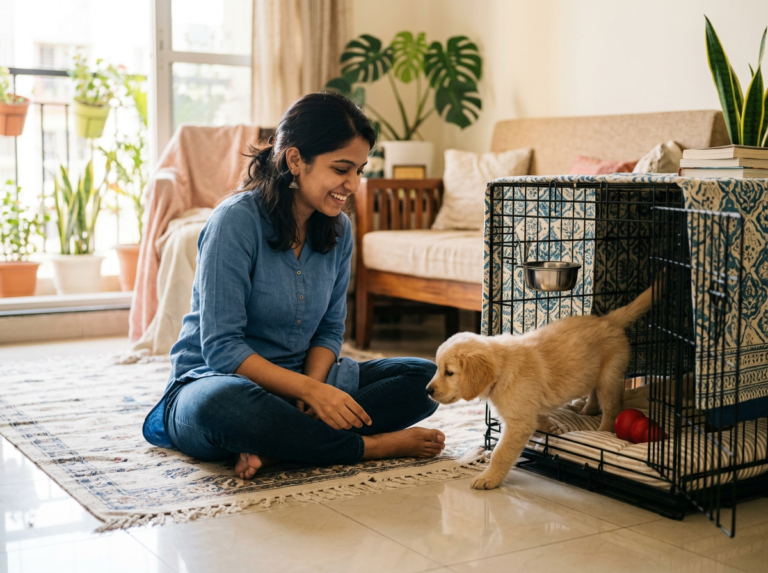
| Crate cover | A light cotton bedsheet or dhurrie draped over the top and three sides of the crate — leaving the front open. Creates a den-like enclosure that reduces visual stimulation. | Do not fully cover all four sides — air circulation is important. Front open, three sides covered. |
| Water in the crate | A small, spillproof metal bowl clipped to the crate wire — not a freestanding bowl that spills. Accessible but not large enough to encourage excessive drinking at 2am. | Clip-on bowls available at most pet stores. A small katori clipped with a binder clip works if needed. |
3. The Pre-Bedtime Routine That Sets Your Puppy Up for a Calmer Night
What you do in the 90 minutes before the crate door closes has more impact on Night 1 than anything you do after the crying starts. The pre-bedtime routine is not optional — it is the primary determinant of how hard Night 1 is.
| Before Bed | Step | What to Do | Why It Matters |
| 90 min | Final play session | 15–20 minutes of active floor play — tug, fetch with a crinkle toy, chase. Get the puppy genuinely tired. Not agitated — tired. | A puppy that has expended physical energy settles significantly faster. The play session also creates a positive pre-crate emotional state. |
| 60 min | Final meal | Last feed of the day. Remove the water bowl 60 minutes before bedtime to reduce the overnight toilet urgency. (Water available until then.) | Limiting water intake in the final hour reduces the chance of a toilet emergency at 1am. Do not restrict water during the day — only the final hour. |
| 30 min | Calm-down window | Stop all high-energy play. Sit quietly. Let the puppy explore at their own pace. Dim any bright lights. Keep voices calm and low. | The nervous system needs a wind-down period. A puppy that goes from high-energy play directly into a crate stays aroused and cries longer. |
| 20 min | Toilet trip | Take the puppy outside (or to their toilet spot) and wait — patiently — until they go. Don’t rush this. Give them 5–10 minutes minimum. | A puppy that has fully emptied before crating sleeps longer and cries less at night. This step directly determines how many night waking-ups you have. |
| 15 min | Crate introduction with treat | Toss a few small treats into the crate and let the puppy go in voluntarily. Close the door for 2 minutes. Open. Treat. Repeat 2–3 times. | If the crate is associated with food before sleep, the puppy enters it in a positive frame rather than being placed in it cold. These 15 minutes reduce the Night 1 crying significantly. |
| 10 min | Crate setup check | Confirm: worn clothing item inside, heat pad under one side of bedding, water bowl (small, spillproof) clipped to crate, a chew or Kong if available. | The crate environment is the puppy’s entire world for the next 6–8 hours. Preparing it properly is worth 10 minutes of your evening. |
| 0 min | Final toilet trip | One more toilet opportunity immediately before crate. Even if they went 20 minutes ago — try again. 8-week puppies can fill a bladder quickly. | The final pre-crate toilet trip is the single most effective way to extend the first sleep stretch. Do not skip this step. |
| 🎯 The Single Most Important Pre-Bed Step |
| The final toilet trip — immediately before crate — is the highest-leverage action in the entire routine. |
| A puppy that empties completely at 10:30pm will often sleep until 1–2am. |
| A puppy with a partial bladder may wake at 11:30pm — setting a cycle that compounds across the night. |
| Wait outside for 5–10 minutes. Let them fully empty. Do not rush this step. |
4. What to Do When They Cry — The 3-Option Decision Tree
| The Decision Tree You Follow Every Time They Cry Not instinct. Not emotion. This framework — every single time. |
This is the most critical section of the blog. When your puppy cries, you need a clear decision framework — because making these calls from instinct, in the dark, half-asleep, while a puppy is crying, produces inconsistent outcomes. Inconsistency is the enemy of crate training.
The following three-option decision tree is what you use every single time the crying starts:
| ❓ Step 1: Is this a toilet cry or a distress cry? |
| Toilet cry signals: whimpering that escalates in urgency, pacing or circling inside the crate, persistent restlessness after more than 2 hours since the last toilet trip. |
| Distress cry signals: howling or barking, settling in short cycles (cries, quietens, cries again), crying that began immediately at crate entry and continues steadily. |
| How to tell: Check the time since last toilet trip. If it has been 2+ hours, toilet need is likely. If it has been less than 90 minutes and the puppy recently went, distress is more likely. |
| 🚽 Option A: It IS a toilet cry — respond with a calm toilet trip |
| Get up quietly. No talking, no eye contact, no play. Minimum stimulation. |
| Carry or lead the puppy directly to the toilet spot. Wait. If they go — calm praise and one small treat. Carry directly back to crate. |
| No detours. No playtime. No picking up for cuddles. The middle-of-night toilet trip is purely functional. |
| Back in crate. Calm ‘good dog’, settle them if needed with one gentle hand on the crate for 30 seconds. Leave. |
| The goal is: puppy learns that crying at 2am for the toilet works (you come) but does not produce anything more stimulating than a toilet trip. This shapes the night-time routine within 3–5 nights. |
| 💙 Option B: It IS a distress cry — the graduated response |
| Do NOT immediately open the crate and take the puppy out. This teaches that crying = release from crate = success. It delays crate acceptance by weeks. |
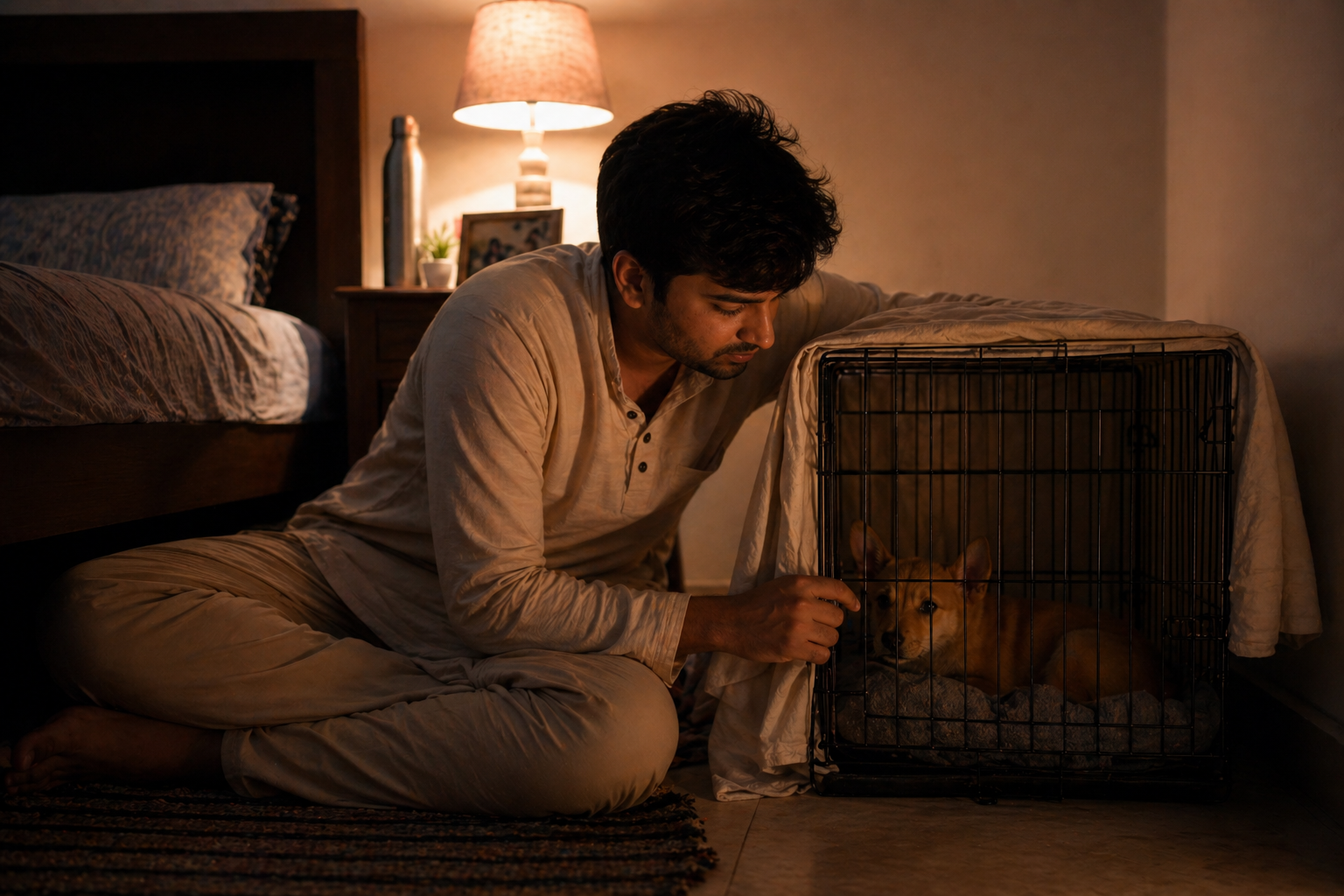
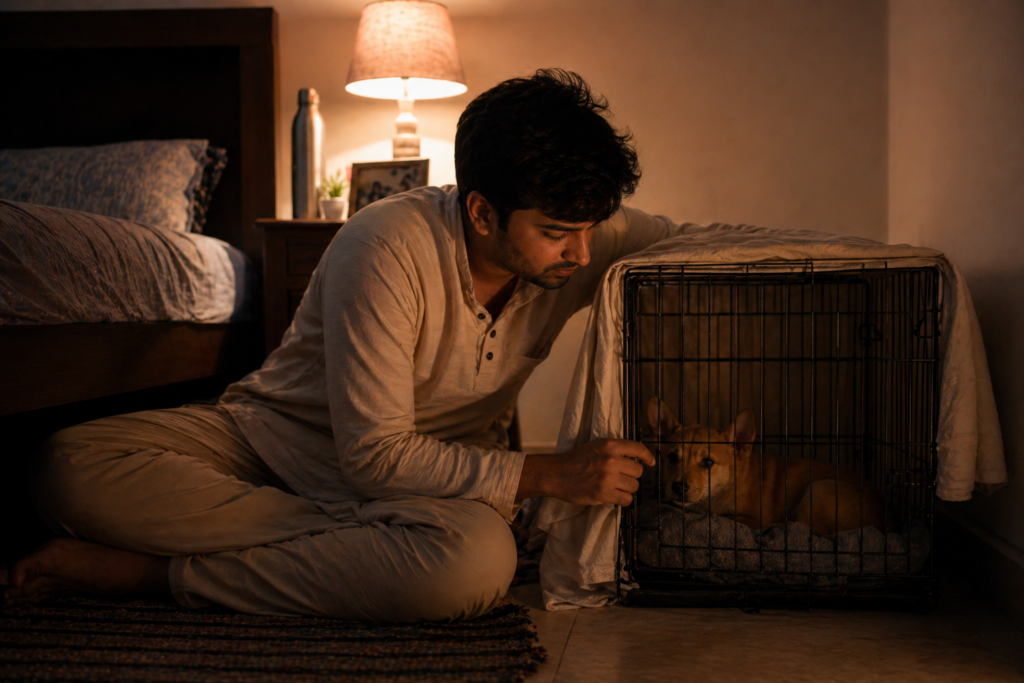
| Instead: Go to the crate. Sit beside it on the floor. Put your fingers through the wire so the puppy can smell you. Speak very quietly: ‘It’s okay. You’re okay.’ Calm, low, steady voice. |
| Do NOT take the puppy out if the crying is distress-only (you have confirmed it is not a toilet need). |
| Stay beside the crate until the crying reduces — typically 5–15 minutes. Then return to your bed. |
| If crying resumes: wait 3–5 minutes before responding again. Each cycle should be slightly longer before response. |
| Most puppies exhaust themselves into sleep within 20–40 minutes on Night 1. The parent’s proximity makes this significantly faster. |
What Consistency Looks Like Across the Night
On Night 1, you may go through this decision tree 3–5 times. That’s normal. The puppy wakes, cries, you assess, you respond appropriately, they settle, they wake again.
Each cycle should use identical logic: is this toilet or distress? If toilet — calm functional trip. If distress — presence without extraction. The repetition of the same response to the same type of cry is what creates the learning. Vary the response and the learning doesn’t happen.
- Toilet cry → functional trip → back in crate: 3 times in a night. Same response all 3 times.
- Distress cry → presence at crate side → settle: 4 times in a night. Same response all 4 times.
- Mix of both → correct identification each time → correct response each time.
The puppy is not trying to defeat you. They are trying to communicate. Your job is to respond to what they’re actually communicating — not to what you fear they might be communicating.
| 🕐 The Timing Rule for Night Responses |
| For toilet cries: respond within 3 minutes — urgency is real. |
| For distress cries: wait 2 minutes before your first visit. Graduate to 3–5 minutes for subsequent visits. |
| The graduated wait teaches that silence (or settling) is what produces your presence — not crying. |
| This single timing rule is the difference between a puppy who learns to self-settle |
| and one who learns to escalate crying until you appear. |
5. What Absolutely NOT to Do on Night 1
Every mistake on this list delays crate training by days. Some of them delay it by weeks. More importantly: most of them happen not because pet parents are careless — but because they are kind, exhausted, and following their instincts in the dark. This section is here specifically because the kind instinct on Night 1 is often the wrong action.
| ❌ Mistake 1: Taking the Puppy Out of the Crate Every Time They Cry |
| Why it delays the process: The puppys brain learns a clean, simple equation: crying = I get out. This equation is extremely difficult to unlearn once established. Night 1 sets this pattern permanently if you follow it consistently — in either direction. The fix: Distinguish between distress and toilet cries (decision tree above). For distress cries: stay near, calm, but do NOT open the crate. For toilet cries: functional trip only, straight back in. The response to each cry type must be different and consistent. |
| ❌ Mistake 2: Ignoring the Crying Completely (Hard Ignoring) |
| Why it delays the process: Leaving an 8-week puppy to cry alone without any proximity response does not produce faster crate acceptance. Research on canine stress responses shows that cortisol stays elevated for significantly longer when no human proximity is available. It is also simply unkind — the puppy is genuinely distressed. The fix: Be present without rewarding the crying with release. Sit near the crate. Speak quietly. Fingers through the wire. Presence without extraction. This is faster AND kinder than hard ignoring. |
| ❌ Mistake 3: Letting the Puppy Sleep in the Bed on Night 1 |
| Why it delays the process: If Night 1 is on the bed and Night 2 is in the crate, the puppy has a direct before-and-after comparison and will protest the downgrade with everything they have. It is significantly harder to crate train a dog that has slept in a human bed than one that has never done so. The fix: If you want the dog on the bed eventually — decide that before Night 1 and commit to it consistently. If you want crate training — the crate is where they sleep from Night 1. Not both. Not alternating. Consistency from the first night is the foundation of the entire process. |
| ❌ Mistake 4: Putting the Crate in a Completely Separate Room |
| Why it delays the process: Covered in Section 2. A puppy alone in a separate room on Night 1 has no proximity comfort, no ability for you to distinguish cry types, and associates the crate with complete isolation. This sets the process back significantly. The fix: Bedroom, beside your bed, Night 1. The crate can be moved gradually once the puppy is sleeping consistently. Get the first week right first. |
| ❌ Mistake 5: Going to the Crate Every Time — Including Immediately |
| Why it delays the process: Responding the instant the puppy makes any sound trains them that any vocalisation produces your appearance. This creates a demand-barking habit that becomes its own significant problem. The fix: For distress cries: wait at least 2 minutes before your first visit. For subsequent distress cries: graduate the wait to 3–5 minutes. You are not being cruel. You are teaching the puppy that not every sound produces an immediate reaction — a lesson that pays dividends for the next 15 years. |
| ❌ Mistake 6: Making the Crate Entry a Drama |
| Why it delays the process: If putting the puppy in the crate for the night involves a long, emotional goodbye — extended petting, extended cooing, a mournful look back as you leave — you are communicating to the puppy that the crate is something to be worried about. The fix: Calm, matter-of-fact crate entry. Treat in, puppy in, door closed, brief calm ‘good night’, lights down. No production. No guilt. The energy you bring to the crate entry is the energy the puppy brings to the first hour inside it. |
| 💙 A Note on Kindness and Firmness |
| Everything in the ‘do not do’ list came from kindness — from not wanting the puppy to suffer. |
| But the kindest long-term outcome for the puppy is a crate they feel safe in. |
| And the path to that goes through a consistent Night 1, not an exception-filled one. |
| You are not being cruel by following the decision tree. |
| You are being the consistent, calm presence your puppy needs to learn that the crate is safe. |
| That is the kindest gift Night 1 can give them. |
6. Night 2 Through Night 7 — What Changes, What Stays the Same
Night 1 is the hardest. Night 2 is sometimes comparable. By Night 5–7, most puppies who experienced consistent Night 1 management are showing clear crate acceptance. Here is what the full first week looks like:
| Night | What to Expect | What to Do | Focus |
| Night 1 | Hardest. Most crying. Typically 1–2 toilet trips needed. Puppy may take 20–45 minutes to settle initially. | Presence near crate during distress. Calm functional toilet trips. No crate release for distress crying. Decision tree throughout. | Survival. You are setting foundations. Even if it is hard, every right decision tonight pays dividends for every night after. |
| Night 2 | Often slightly harder than Night 1 for some puppies — the second night dip is real. Don’t be discouraged if Night 2 feels worse. | Identical approach to Night 1. Same routine. Same response. No variations based on Night 1 outcome. | Absolute consistency. Night 2 is where the foundation either holds or starts to crack. |
| Night 3 | Most puppies show the first signs of settling faster. The initial cry period shortens. This is the first evidence that the process is working. | Same routine. Same response. If the puppy is settling within 15 minutes — that is significant progress. Note it. | Notice improvement without relaxing the approach. Progress is not permission to start making exceptions. |
| Night 4 | Discernible improvement for the majority of puppies. Fewer night wake-ups. Slightly longer first sleep stretch. Some puppies start going through to 3–4am. | Continue routine exactly. Begin very slightly extending the wait time for distress cries — 3 minutes before responding instead of 2. | Consolidation. The pattern is forming. Protect it. |
| Night 5 | Many puppies are now settling within 5–10 minutes of crate entry. One toilet trip per night is becoming the norm rather than two. | Maintain routine. If the puppy is settling quickly, you may find you are no longer needed at the crate side. This is success. | Trust the process. Don’t introduce new variables because it seems to be going well. Stay consistent. |
| Night 6 | The majority of puppies are showing significant crate acceptance by Night 6. Crying at entry has reduced or stopped. Toilet rhythm is becoming predictable. | Same routine — but the energy can now be lighter. You can move through the steps with confidence rather than anxiety. | You are close to the other side. The work of Week 1 is nearly done. |
| Night 7 | Most puppies with consistent Night 1–6 management are sleeping in the crate with minimal protest. One toilet trip per night. First real sign of the crate as the puppy’s own space. | Celebrate quietly. Your puppy now has a home inside your home. You laid that foundation in seven nights. | The crate has become a safe space. Now maintain it — never use it as punishment, always keep it associated with positive things. |
What Stays Identical Every Night of Week 1
These elements do not change from Night 1 to Night 7, regardless of how well or badly the previous night went:
- The pre-bedtime routine: play, meal, calm-down window, toilet trip, crate introduction with treat, setup check, final toilet trip
- The crate location: bedroom, beside your bed, every night until sleeping consistently
- The decision tree: every cry is assessed for toilet vs distress, every time
- The response to distress cries: presence without extraction, graduated wait times
- The response to toilet cries: functional trip only, straight back in, no stimulation
- The tone and energy: calm, matter-of-fact, no guilt, no drama
What does change: your confidence, your puppy’s familiarity with the crate, the speed with which they settle, the duration of initial crying, and ultimately — the amount of sleep you both get.
The 7-Night Milestone — What It Means
By the end of Night 7 with consistent management, your puppy has done something genuinely significant: they have learned that the crate is their space, that their person is nearby, that their needs will be met, and that silence and settling produces more good things than crying does.
That learning — established in seven nights — is the foundation of a crate-trained dog for life. The crate becomes a safe space they seek out voluntarily. A place they go when overwhelmed, when tired, when the world is too much. For Indian apartment dogs especially — without a garden to retreat to, without space to decompress — this voluntary den is one of the most valuable things you can give your dog.
Seven nights. Consistent. That is all it takes.