Here Is What Actually Helps
By Harshad | Founder, Indieedogs | Puppy Training & Behaviour Specialist
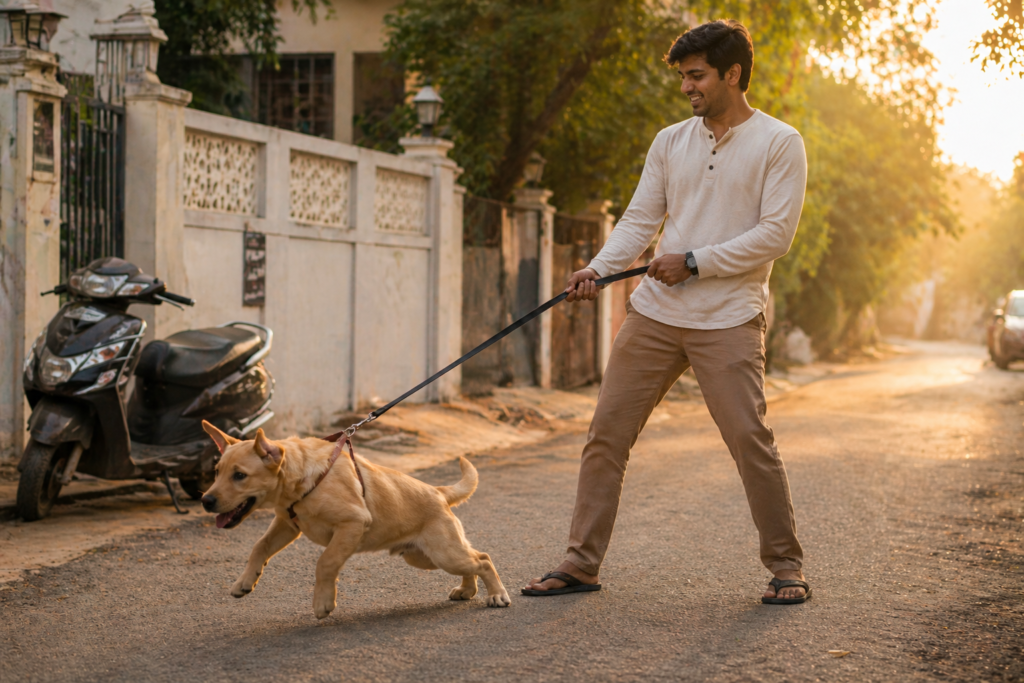
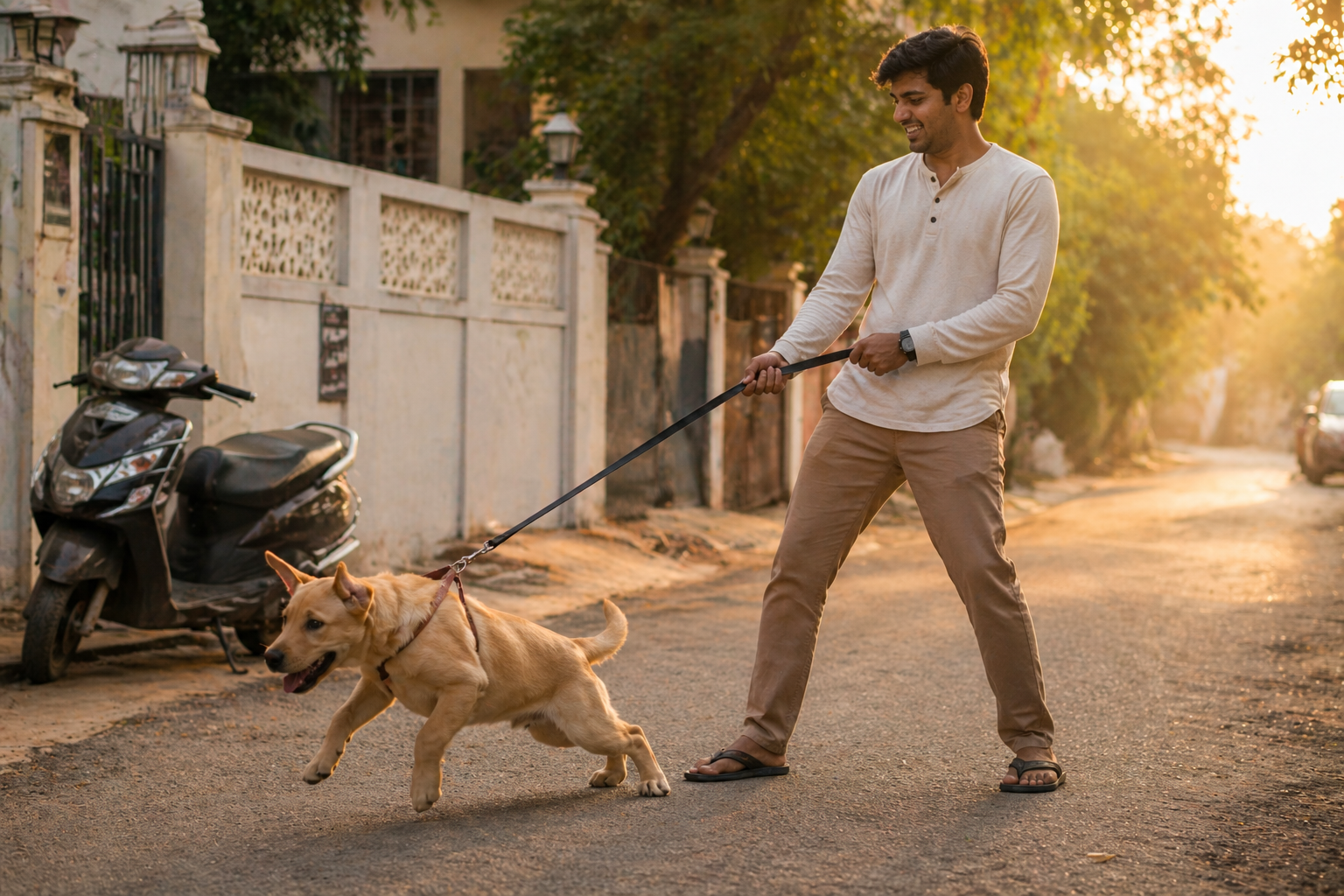
Every morning, somewhere in India, a pet parent steps out for a walk and immediately gets yanked down the footpath by a 4-kilogram puppy who apparently wants to be everywhere except next to them.
If that sounds familiar — welcome. Leash pulling is one of the most universal frustrations in puppy training. It starts small, feels manageable, and then suddenly you’ve got a 6-month-old Labrador treating every walk like it’s the opening leg of a relay race.
The good news? Leash pulling is not a personality flaw. It’s not a stubborn dog. It’s not a breed problem — though I’ll admit Labradors, Beagles, and Indie dogs do deserve a special mention here. It’s simply a dog that hasn’t been taught yet that pulling doesn’t work.
And the even better news: with the right method and 2 weeks of consistency, most puppies show significant improvement. I’ve seen it happen over and over. This guide will show you exactly how.
1. Why Puppies Pull — The Simple Physics and Psychology Every Parent Needs to Understand
Before you can fix leash pulling, you need to understand why it happens in the first place. Because once you see it clearly, the solution becomes obvious.
There are two things working against you every time your puppy pulls: the physics of the leash and the psychology of what your puppy has already learned.
| ⚙️ The Physics | 🧠 The Psychology |
| When your puppy pulls forward, you instinctively pull back. That counter-tension tells your puppy’s body: something is resisting me. The harder they pull, the harder you pull. Result: a tug-of-war loop that never ends — and actually builds your puppy’s pulling muscles over time. | Your puppy has learned one thing from every previous walk: ‘Pulling = I get to go where I want.’ That’s a powerful reward loop. Every time pulling worked — even once — it was reinforced. The leash tension is not a signal to stop. It’s just the feeling that comes before getting what they want. |
Put those two together and you get a system that rewards pulling every single time — even when you think you’re resisting it. Your counter-pull is actually stimulating your puppy to pull harder (oppositional reflex). And every walk where they eventually got where they wanted to go? That was a training session that reinforced pulling.
This is the part nobody tells you: you haven’t been failing at stopping the pulling. You’ve been accidentally training your puppy to pull better. And that’s completely fixable — once you change the system.
| 💡 The Insight That Changes Everything |
| Your puppy doesn’t pull because they’re bad or wilful. |
| They pull because pulling has worked — every single time. |
| To stop the pulling, you don’t need to pull harder. |
| You need to make pulling completely and utterly unrewarding. |
2. Why Shouting No and Jerking the Leash Actually Makes Pulling Worse Over Time
| The Hard Truth The most instinctive reactions to leash pulling are also the most counterproductive. |
Let’s talk about the two things most pet parents try first — because they feel like the natural response.
The Jerk-and-Pull Reaction
When your puppy lunges forward, your instinct is to jerk the leash back and say ‘No!’ or ‘Stop!’ It feels like correction. It feels like communication.
But here’s what’s actually happening from your puppy’s perspective:
- The leash jerk gives them physical stimulation — which can actually increase arousal and excitement
- Your voice becomes background noise associated with leash tension — it doesn’t carry meaningful information to them
- The oppositional reflex kicks in: the pull-back makes them pull forward harder, like a reflex — it’s hardwired into their nervous system
- After the jerk, you keep walking — which means pulling was eventually rewarded again
Repeated leash jerks over weeks can also cause neck strain — especially in smaller breeds — and can create leash reactivity in some dogs, where the tension of the leash starts triggering anxiety or frustration responses. I’ve seen this happen with Indie dogs particularly, who are sensitive to physical pressure.
The Constant ‘No’ Shouting
Saying ‘No!’ repeatedly while your dog pulls is one of the least effective things you can do in dog training — and here’s why: dogs don’t generalise the word ‘No’ the way we assume they do.
To your puppy, ‘No’ during leash pulling means nothing specific. It doesn’t tell them what to do instead. And if you keep walking while saying it, you’ve just confirmed that ‘No’ doesn’t actually mean anything needs to change.
The pattern becomes: Pull → human says ‘No’ → walk continues → pulling reinforced.
| ⚠️ What to Do Instead of Shouting or Jerking |
| Stop completely. Say nothing. Don’t pull back. |
| Become a statue. Your stillness is the message. |
| Wait for any slack in the leash — then reward that with forward movement. |
| The reward for not pulling is the walk continuing. Simple. Powerful. Consistent. |
3. The Stop-and-Wait Method — How It Works and Why Dogs Respond Within Days
| The Stop-and-Wait Method Simple, calm, and remarkably effective — especially for puppies under 5 months. |
This is the method I recommend first for most puppies — and it works because it directly targets the reward system that’s been reinforcing pulling. The logic is simple: if pulling makes the walk stop, and a loose leash makes the walk continue, your puppy will choose the loose leash.
It sounds almost too simple. But the science behind it is solid, and I’ve seen it work within 3–5 days with consistent application.
| Step | Moment | What You Do |
| 1 | Puppy pulls forward | Stop completely. Plant your feet. Don’t say anything. Don’t pull back. Just become a tree. |
| 2 | Puppy looks back at you | The moment there’s slack in the leash — even for a second — say ‘Yes!’ and take one step forward as the reward. |
| 3 | Puppy pulls again | Stop again. Same reaction. No frustration, no commentary. Just stop. |
| 4 | Puppy stays near you | Mark it with ‘Yes!’ and keep walking. Reward the loose leash, not the sitting. |
| 5 | Repeat for entire walk | Your walk may cover 50 metres in 15 minutes at first. That’s fine. The lesson is being taught. |
That’s it. There’s nothing else to it. The magic is entirely in the consistency.
Why It Works So Fast
Dogs are constantly running a cost-benefit calculation. Pulling = walk stops. That’s a cost your puppy immediately registers. Within a few repetitions, they start experimenting with not pulling — and when that gives them a moving walk, the association forms quickly.
Most pet parents see the first signs within 2–3 walks. The puppy starts hesitating before pulling. They start glancing back at you. These are early signs that the lesson is landing.
Important: Location Matters
Start the stop-and-wait method in a low-distraction environment first. Your building compound, a quiet residential lane, or a familiar stretch of road. Indian streets — with their stray dogs, street food smells, motorcycles, and general chaos — are too stimulating for a puppy that’s just learning.
Once your puppy consistently walks on a loose leash in a calm environment, you gradually introduce more distractions. Don’t rush this progression.
| 📍 India-Specific Note |
| Training on busy Indian streets too early is one of the most common mistakes I see. |
| The overstimulation overwhelms a puppy’s learning capacity. |
| Start inside your building compound or a quiet residential lane. |
| Labrador and Indie dog owners especially — your dogs have high stimulus sensitivity. Go slow early. |
4. The Direction Change Method — For Stronger Pullers and Indie Dogs
| The Direction Change Method For the dog that just won’t wait — and for Indie dogs with high environmental drive. |
Some puppies — particularly Indie dogs (Indian Pariah Dogs), Labradors, and Beagles — are so environmentally motivated that the stop-and-wait method alone doesn’t give them enough feedback. They’ll stand there while you stop, then the moment you move again, they charge forward.
For these dogs, the direction change method is more effective because it does something the stop-and-wait doesn’t: it actively removes the thing they’re pulling toward.
Your puppy wants to get to that smell across the road. When they pull toward it, you turn and walk the other way. Suddenly, they’re moving further from the reward, not closer. The message is unmistakable.
| What Happens | What You Do |
| Puppy pulls ahead | Calmly say ‘This way’ and turn 180° in the opposite direction. Walk confidently. |
| Puppy follows (or scrambles to catch up) | Good. No reward needed — keeping up with you IS the reward for now. |
| They pull again in new direction | Turn again. Same calm response. You are the one deciding where the walk goes. |
| They walk beside you with a loose leash | Mark with ‘Yes!’ and a small treat. This is the behaviour you want to cement. |
| Repeat over 10–15 minutes | With strong pullers, do this in a low-distraction area first — inside your building compound, not a busy road. |
The Indie Dog Consideration
Indian Pariah Dogs are naturally alert, highly scent-driven, and have strong environmental awareness — shaped by thousands of years of street survival. This makes them naturally curious on walks, constantly wanting to investigate every smell, sound, and movement.
For Indie dogs, the direction change method works brilliantly once they understand the pattern. But expect more repetitions in the first few days compared to other breeds. Their environmental drive is high, and it takes slightly longer for the lesson to override that instinct.
What I’ve found works especially well with Indie dogs: turn the direction changes into a game. Move confidently and happily in the new direction, saying ‘Let’s go!’ in an upbeat tone. Your energy signals to them that the new direction is worth following. They respond to your enthusiasm.
Combining Both Methods
For most dogs, the best approach is to use both methods together — stop-and-wait in familiar environments, direction change when distraction increases. Think of them as your two tools: one for building the foundation, one for challenging environments.
Once your puppy is consistently walking on a loose leash in calm areas, gradually introduce the direction change only when distraction causes a relapse. You’re not starting over — you’re just reinforcing the lesson under harder conditions.
| 🐕 Gear Note for Indian Pet Parents |
| Use a flat collar or well-fitted harness for leash training. |
| Avoid retractable leashes entirely during training — they teach your puppy that pulling extends the leash. |
| A 1.2m to 1.5m fixed leash gives you control without excess slack. |
| For Labradors and strong Indie dogs over 5 months: a front-clip harness significantly reduces pull force |
| while you’re still building the training foundation. |
5. How to Make Walks Enjoyable Again — Within 2 Weeks of Consistent Practice
Here’s what nobody tells you when you’re in the middle of leash training: the first week is going to feel backwards. Your walks will be shorter. Slower. More frustrating in some ways, because you’re stopping constantly.
But there’s a moment — usually around Day 8 to 10 — where something shifts. Your puppy starts checking in with you on the walk. They glance back. The leash hangs loose for a few steps. And you realise: this is actually enjoyable.
That’s the goal. Here’s how to get there systematically.
| Period | What You’ll See | What to Focus On | Success Marker |
| Days 1–3 | Slow, stop-and-start walks. Puppy confused by stops. | Don’t rush. Stops are the lesson. | Puppy pauses after your stop |
| Days 4–6 | Slightly faster response to stops. Fewer consecutive pulls. | Start rewarding any loose leash moment. | 2–3 steps of loose leash in a row |
| Days 7–9 | Puppy checks back at you more often during walk. | Mark and reward the check-ins generously. | Puppy glances at you without prompting |
| Days 10–14 | Noticeably less pulling. Walks feel lighter. | Try slightly busier environments. Build on success. | Full 5 mins of loose-leash walking |
Making the Walk Rewarding for Both of You
Leash training shouldn’t just be about preventing pulling. It should be about building an experience your puppy genuinely enjoys — and one that makes you want to take them out every day.
- Let your puppy sniff during designated sniff stops — sniffing is mentally exhausting for dogs in the best way; it tires them out faster than walking
- Vary your route once loose leash behaviour is established — new smells and sights keep your puppy engaged with you, not just the environment
- Bring 3–4 small high-value treats on every walk in the first two weeks — use them to mark and reward check-ins and loose leash moments
- Keep sessions to 15–20 minutes in early training — shorter, focused walks teach more than long chaotic ones
The Check-In Reward — Your Secret Weapon
Every time your puppy looks back at you during a walk — unprompted — that’s worth a party. Mark it with ‘Yes!’ and give a treat. You are building the habit of your puppy checking in with you, which naturally keeps them from pulling ahead. It’s one of the most underused techniques in leash training, and it works beautifully with Indian breeds that are highly responsive to positive reinforcement.
| 🏆 What Success Looks Like at 2 Weeks |
| Your puppy walks beside you for stretches without pulling. |
| They glance back at you regularly without being prompted. |
| When they do pull, they respond to your stop within 1–2 seconds. |
| Your walk covers proper distance — not 50-metre-stop marathons. |
| You’re both actually enjoying it. That’s the real marker. |
6. The Full Leash Training Video Guide — Built for Indian Streets and Apartments
Reading this guide gives you the framework. But leash training has a lot of nuance that’s hard to capture in text — the timing of your stop, the exact moment to reward, how to handle a puppy that sits down in protest, how to manage pulls when a stray dog appears out of nowhere on an Indian street.
That’s why we built the Indieedogs leash training video guide — specifically for the realities of training a puppy in India.
- Filmed in real Indian apartment compounds, streets, and parks — not international settings that don’t translate
- Covers both the stop-and-wait and direction change methods with step-by-step demonstrations
- Includes breed-specific tips for Labradors, Golden Retrievers, German Shepherds, Beagles, and Indie dogs
- Addresses common Indian-specific challenges: stray dogs on walks, traffic distraction, narrow footpaths, inconsistent flooring
- Complete module on transitioning from leash training to off-leash recall in safe environments
3 Things to Try on Your Very Next Walk
- Before you clip the leash: Ask your puppy to sit. Clip the leash only when they’re calm. Walking begins from calm, not excitement.
- The first time they pull: Stop. Say nothing. Plant your feet. Wait for slack — even a centimetre of it. Mark it with ‘Yes!’ and take one step forward.
- Every time they look back at you: Mark it and reward. Even if they looked back because you stopped. The check-in habit is the foundation of every good walk.
That’s three things. All you need for your next walk. Add them, stay consistent for 5 walks, and I promise you’ll feel the difference.